
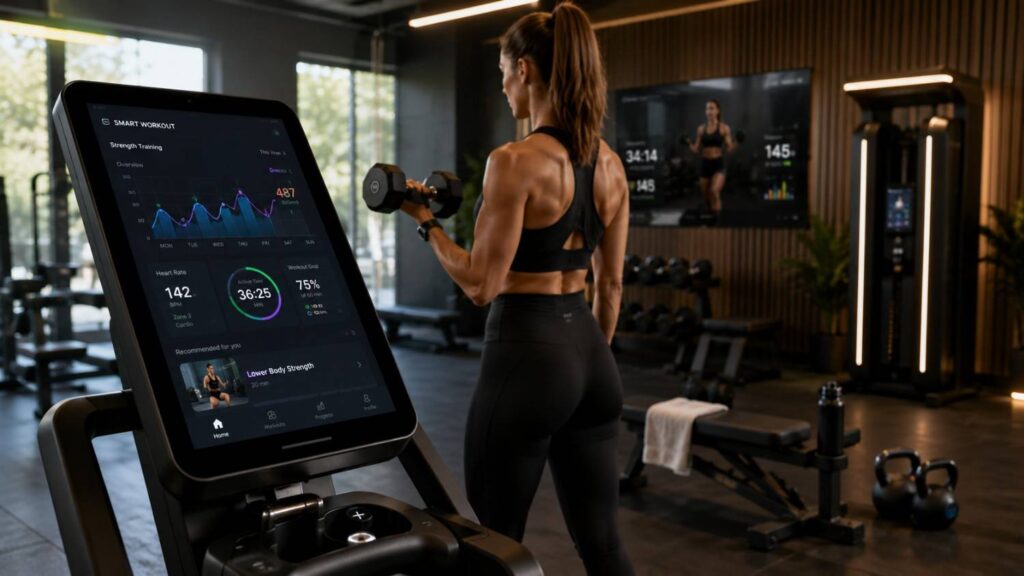
The Best Smart Gym Equipment for 2026
The best smart gym equipment for 2026 combines durable exercise hardware with software that provides measurable training value. That value may come from automatic resistance, guided classes, adaptive programming, motion tracking, real-time feedback, performance history, or easier progression.
The category now includes wall-mounted strength trainers, freestanding digital cable systems, camera-guided dumbbell platforms, connected exercise bikes, intelligent rowing machines, and treadmills that automatically change speed and incline.
However, a product should not be considered “best” simply because it includes artificial intelligence, a large touchscreen, or an expensive membership. The physical machine must suit the user’s goals, body size, ability, available space, and preferred type of exercise.
A connected strength machine may be ideal for someone who wants guided progressive overload but unsuitable for an advanced lifter who requires resistance beyond its digital limit. A smart rower may provide excellent full-body conditioning but remain unused if the buyer does not enjoy rowing. A treadmill may support walking and running goals but require more space, power, and safety planning than expected.
The complete ownership experience also matters. Buyers should compare the initial hardware price with required accessories, delivery, professional installation, monthly subscriptions, extended warranties, repairs, and replacement parts.
Software dependence deserves special attention. Tonal requires a membership for the first 12 months and reserves most intelligent features for active members. Hydrow allows a basic “Just Row” mode without a subscription, while Tempo’s complete connected experience depends on its membership and compatible phone hardware.
This guide therefore ranks products by category and practical use rather than naming one machine as the correct choice for every home.
What Makes Smart Gym Equipment Worth Buying in 2026
Smart gym equipment becomes worthwhile when its digital features solve a real training problem. The technology should reduce uncertainty, make progression easier, improve workout consistency, or provide guidance that the user would otherwise struggle to obtain.
Automatic resistance is one of the clearest examples. Digital strength machines can change weight without plates and may adjust resistance in one-pound increments. This reduces downtime between exercises and makes gradual progression easier to manage.
Adaptive cardio features can also provide meaningful value. A treadmill that changes incline and speed during a guided session can remove the need to operate controls constantly. A connected bike that follows instructor resistance cues may create a smoother class experience.
Performance tracking is useful when it measures information that supports decisions. Strength users may need volume, resistance, range of motion, and rep history. Cyclists may focus on cadence, output, heart rate, and resistance. Rowers may monitor pace, strokes per minute, power, and technique.
The platform should also support consistency. Useful programming considers training goals, previous performance, available time, and equipment limitations. It should provide a clear next session rather than simply presenting thousands of classes without direction.
There are disadvantages. Connected equipment can become dependent on memberships, internet access, manufacturer servers, proprietary accessories, and software support. A durable steel frame may last much longer than its touchscreen or operating system.
For that reason, buyers should evaluate the exercise machine and digital platform separately. The best product should remain physically suitable even when the novelty of classes, badges, or leaderboards fades.
For readers who want another editorial perspective before making a purchase, this roundup of smart home gym picks offers additional comparisons across today’s leading connected fitness systems.
Smart Features That Provide Real Training Value
The most valuable smart features directly affect exercise quality or progression. Automatic resistance can reduce setup time and make gradual increases easier. Tonal automatically recommends and adjusts weight after a strength assessment, while its digital system can progress in small increments and use modes such as Chains and Eccentric.
Speediance also provides electronically controlled resistance with Standard, Chain, Eccentric, and Constant modes. Its dual motors can deliver different resistance to each side, which may help users address strength imbalances or perform independent cable movements.
Camera-based tracking can be valuable when it provides clear and limited feedback. Tonal’s Smart View camera analyzes movement and provides coaching cues. Tempo uses compatible iPhone cameras to recognize weights, count repetitions, and support form feedback in suitable exercises. Peloton’s movement-tracking camera can provide rep tracking, form feedback, and weight suggestions during compatible off-bike training.
Other useful features include household profiles, heart-rate monitor support, workout history, free-training modes, automatic treadmill adjustments, and integrations with platforms such as Apple Health and Strava.
A smart feature provides real value when it helps the user train more consistently, safely, progressively, or efficiently.
Smart Features That May Not Justify the Cost
Some smart features are appealing during a product demonstration but may provide limited long-term value. Large touchscreens can make guided sessions immersive, yet they also increase hardware cost and may become difficult to repair when the display or operating system ages.
Large class libraries can create the appearance of greater value without improving decision-making. A user may have access to thousands of sessions but continue repeating only a few favourite workouts. Personalized programming is often more valuable than content volume alone.
Leaderboards, virtual rewards, streaks, and social challenges can motivate some people. Others may stop using them after the first few months. Buyers should decide whether competition and community genuinely support their habits.
AI-generated recommendations also require realistic expectations. A platform may use previous performance and selected goals, but it may not fully understand pain, injury history, rehabilitation needs, medical restrictions, or technical movement problems.
One of the most important questions is what remains available without a subscription. Hydrow, for example, retains a basic Just Row mode with time, distance, stroke rate, adjustable resistance, and limited introductory material when membership is inactive. Tonal requires membership during the first year and reserves most intelligent functions for subscribers.
A machine should still offer reasonable exercise value if the household later reduces spending or loses interest in the connected service.
Best Smart Strength Equipment for 2026
Smart strength systems follow three main designs. Tonal uses wall-mounted adjustable arms and electronically generated cable resistance. Speediance uses a freestanding frame with dual motors, adjustable pulleys, and a folding platform. Tempo Move combines physical dumbbells and plates with camera-guided digital coaching.
These designs create different exercise experiences. Digital cable resistance allows rapid weight changes and advanced modes without storing a large collection of plates. Physical weights feel more familiar and remain useful without powered motors, but they require manual adjustment and have lower total resistance in compact packages.
Installation is another major difference. Tonal must be professionally mounted to a suitable wall and requires a defined clear training area. Speediance requires floor space and electrical power but does not require drilling. Tempo Move uses a small cabinet, compatible iPhone, and television, although its camera features need approximately six feet by six feet of clear space.
Resistance limits should be considered carefully. Tonal 2 provides up to 250 pounds of total personalized digital resistance. Speediance Gym Monster 2 provides up to 220 pounds, with 110 pounds available from each arm. Tempo Move Plus includes 90 pounds of physical weight, making it more appropriate for beginners and intermediate dumbbell training than heavy barbell-style lifting.
Membership dependence also varies. Tonal requires an initial commitment. Tempo bundles include the first year and then move to a monthly plan. Buyers should verify current Speediance subscription terms because available service packages may change.
| Product | Best For | Main Smart Feature | Key Requirement | Membership Position |
|---|---|---|---|---|
| Tonal 2 | Guided wall-mounted strength | Adaptive resistance and camera coaching | Professional installation and 7 × 7-foot area | Initial 12-month commitment required |
| Speediance Gym Monster 2 | Freestanding digital lifting | Dual-motor resistance and guided programmes | Floor space, power, and heavy-machine delivery | Verify current plan and feature terms |
| Tempo Move | Compact physical-weight training | iPhone-based weight and movement tracking | Compatible phone, TV, and 6 × 6-foot area | First year included with current bundles |
Tonal 2 — Best Overall Smart Strength System
Tonal 2 is the strongest overall choice for users wanting a highly guided digital strength experience in a compact wall-mounted format. It provides resistance from five to 250 pounds, supports more than 300 movements, and automatically recommends weight after an initial strength assessment.
Its adjustable arms support pressing, pulling, squatting, deadlifting, rowing, and accessory movements when used with the required handles, bar, rope, bench, and control module. Dynamic modes can change how resistance behaves through the repetition, while the built-in Smart View camera can provide coaching cues and post-workout clips.
Tonal requires careful space planning. The official installation guidance specifies approximately seven feet of unobstructed wall, a seven-by-seven-foot floor area, a ceiling height of seven feet ten inches, reliable Wi-Fi, and a nearby grounded outlet. Professional installation is required.
The membership currently costs $59.95 per month plus applicable taxes, and purchased systems require an initial 12-month commitment. Most intelligent features require an active membership.
Tonal is best for households committed to structured strength training. It is less suitable for renters, users unwilling to mount equipment, or lifters who regularly exceed its resistance limit.
Speediance Gym Monster 2 — Best Freestanding Digital Gym
Speediance Gym Monster 2 is the leading freestanding alternative for users who want digital resistance without permanent wall installation. The machine uses dual direct-drive motors and provides up to 220 pounds of total resistance, with each arm capable of delivering up to 110 pounds. Resistance can be adjusted in small increments.
Its Standard, Chain, Eccentric, and Constant modes change how resistance behaves during movement. The platform can support exercises such as squats, presses, deadlifts, pulldowns, rows, flies, and accessory work when used with the appropriate attachments.
The freestanding design is valuable for renters and homeowners who may relocate the machine. Speediance states that Gym Monster 2 requires no drilling or wall mounting and can fold from approximately 48 inches deep to about 14.6 inches deep. The machine itself weighs roughly 172 pounds, so delivery access and floor suitability still matter.
Its main limitation is the 220-pound resistance ceiling. Stronger users may outgrow it for bilateral deadlift or squat patterns even though unilateral movements remain challenging.
Buyers should confirm the included accessory package, warranty, current software or membership terms, delivery service, and availability of local repairs before ordering.
Tempo Move — Best Compact Free-Weight System
Tempo Move is the best compact option for users who prefer physical dumbbells and plates rather than digitally generated cable resistance. The Move Plus package includes adjustable dumbbells, compatible colour-coded plates, a workout mat, a small storage cabinet, and 90 pounds of total weight.
Tempo’s system uses an iPhone camera to recognize compatible weights, count repetitions, estimate range of motion, and provide feedback during supported exercises. The Core connects the phone to a television through compatible HDMI or display hardware.
The cabinet measures approximately 22 inches high and 13.5 inches wide and deep. The equipment itself is compact, but Tempo recommends a clear six-by-six-foot workout area for accurate movement tracking.
Device compatibility is the main concern. The complete Core experience requires a supported iPhone and television or display. Different phone generations may require different Lightning or USB-C Core hardware, and certain models are excluded.
Current Tempo bundles include a prepaid first year of membership, after which the standard monthly membership is listed at $39.
Tempo is best for beginners and intermediate users who want guided free-weight training in a multipurpose room.
Related Articles
Best Smart Cardio Equipment for 2026
Smart cardio equipment adds guided classes, automatic adjustments, performance data, scenic workouts, and personalized recommendations to exercise bikes, rowers, and treadmills. The underlying movement should still guide the purchase.
A connected bike is suitable for users wanting relatively compact, low-impact cardiovascular training. A rower provides coordinated leg, back, arm, and core involvement but requires a longer operating footprint and appropriate technique. A treadmill is the most familiar choice for walking and running, although it normally requires the greatest floor area and creates more noise and impact.
The software platform matters because cardio machines often depend heavily on classes and automatic adjustments. Peloton emphasizes live and on-demand content, instructor-led cycling, Peloton IQ, community features, and cross-training. Hydrow focuses on guided rowing filmed on water, HydroMetrics feedback, and household profiles. NordicTrack uses iFIT to adjust speed, incline, decline, and training intensity.
User limits must be checked before buying. Peloton publishes height, age, and weight requirements for the Bike+. Hydrow publishes a 375-pound weight limit and a maximum 36-inch inseam for the Wave. NordicTrack publishes model-specific performance specifications that buyers should confirm on the current product page.
Motorized equipment requires additional safety planning. Treadmill history should be checked through the CPSC recall database, particularly for used equipment. In April 2026, CPSC warned users to stop using several Sperax walking-pad and treadmill models because of unexpected speed changes, abrupt stops, and fire hazards.
Peloton Cross Training Bike+ — Best Smart Exercise Bike
Peloton Cross Training Bike+ is the strongest connected exercise bike for users who value instructor-led classes, community features, cycling metrics, and off-bike strength training. The current model has a 23.8-inch rotating touchscreen, automatic resistance, a compact four-by-two-foot footprint, and a movement-tracking camera powered by Peloton IQ.
The camera can provide real-time form feedback, repetition tracking, and weight suggestions during compatible strength sessions. Peloton states that use of the camera is optional and that images and video are not recorded or stored during movement tracking.
The Bike+ records metrics such as cadence, resistance, output, and heart rate when compatible monitoring is connected. Its screen rotates for strength, yoga, mobility, and other floor sessions.
Current U.S. specifications list a user-height range of approximately 4 feet 11 inches to 6 feet 5 inches, a maximum user weight of 297 pounds, and a minimum age of 14. The pedals require cycling shoes with Delta-compatible cleats.
The Peloton All-Access Membership is currently listed at $49.99 per month and is required for complete equipment content and applicable features.
Peloton is best for class-motivated households rather than riders wanting a simple subscription-free indoor bike.
Hydrow Wave — Best Smart Rowing Machine
Hydrow Wave is the strongest connected rower for users wanting instructor-led rowing, scenic sessions, technique feedback, and a narrower frame than many full-size rowers.
The machine measures approximately 80 inches long, 19 inches wide, and 43 inches high during use. It weighs about 102 pounds and supports users up to 375 pounds with an inseam of up to 36 inches. Vertical storage requires a separately sold anchor; Hydrow advises against storing the rower upright without it.
The 16-inch touchscreen supports guided workouts, while HydroMetrics evaluates Precision, Power, and Endurance. Connectivity includes Wi-Fi, Bluetooth, ANT+, and optional Ethernet. Hydrow also supports fitness integrations such as Apple Health, Strava, Fitbit, and Garmin.
The household membership is currently $50 per month and includes thousands of rowing and mat workouts, personalized recommendations, performance tracking, community features, and unlimited profiles.
A subscription is not mandatory for basic exercise. Without membership, users retain Just Row mode, adjustable drag, and basic metrics such as time, distance, and stroke rate.
Hydrow Wave is best for users who enjoy rowing enough to justify its long active footprint and ongoing membership.
NordicTrack Commercial 1750 — Best Smart Treadmill
NordicTrack Commercial 1750 is a strong smart treadmill for walkers, joggers, and intermediate runners who want automatic workout adjustments and a screen that can support both treadmill and floor-based sessions.
The current model has a 16-inch pivoting HD touchscreen, speeds of up to 12 miles per hour, and a range from 12 percent incline to negative 3 percent decline. The deck folds upward to reduce the machine’s footprint when not in use.
With an iFIT Pro membership, the treadmill can automatically adjust speed, incline, decline, and intensity to follow the instructor, terrain, user fitness level, and compatible heart-rate targets. The platform also provides access to a large workout library and off-treadmill content through the rotating display.
The main disadvantages are its size, weight, delivery complexity, electrical requirements, and dependence on iFIT for the complete adaptive experience. A folding deck reduces stored space but does not remove the need for a safe operating area.
Buyers should measure doorways, stairs, ceiling clearance, room ventilation, and space behind the belt. Children and pets should remain away from the machine during operation, and the safety key should be stored securely.
Before buying a used treadmill, search the exact model and serial information through the CPSC recall database because treadmill recalls and warnings can involve sudden speed changes, falls, overheating, or fire hazards.
How to Compare Smart Gym Equipment Before Buying
A structured comparison prevents buyers from choosing equipment based on one impressive demonstration. Begin by defining the primary training goal. Strength, cycling, rowing, walking, and running require different machines and should not be ranked only by screen size or number of classes.
Next, measure the room. Include the machine footprint, active exercise area, screen movement, accessory storage, ceiling height, delivery access, ventilation, and space needed to enter or exit safely. A compact stored footprint can be misleading when the workout requires several additional feet.
Calculate the complete cost over at least three years. Include hardware, delivery, installation, accessories, membership, floor protection, cycling shoes, heart-rate monitors, extended warranties, and likely maintenance. Promotional discounts should not be treated as permanent pricing.
Review what happens after cancellation. Determine whether the equipment keeps manual resistance, basic performance metrics, free-training modes, workout history, or local controls. A machine that becomes largely unusable without a subscription carries greater financial risk.
Investigate service coverage. Heavy connected equipment can be expensive to move and difficult to repair. Confirm whether in-home service, replacement parts, software updates, and phone support are available in your region.
Comparing manufacturer specifications with independent equipment reviews can also help verify real-world usability, long-term value, and practical ownership considerations before purchasing.
Finally, read the return policy before delivery. Some products require original packaging, professional removal, restocking charges, or return shipping. A 30-day trial is most useful when the buyer understands exactly how it begins and what conditions apply.
The best comparison focuses on long-term usability, not only initial excitement.
| Buying Factor | Why It Matters | What to Check Before Buying |
|---|---|---|
| Training Goal | Ensures the machine matches your fitness needs | Strength, cardio, weight loss, or full-body training |
| Available Space | Prevents installation issues | Measure workout area, ceiling height, and clearance |
| Installation | Some systems require professional setup | Wall mounting, electrical outlet, floor stability |
| Resistance Capacity | Determines long-term usability | Maximum resistance and progression options |
| Subscription Requirement | Affects long-term ownership cost | Features available with and without membership |
| Smart Features | Improve workout experience | AI coaching, automatic resistance, form tracking |
| Warranty & Support | Reduces repair risk | Warranty period, local service availability |
| Software Updates | Keeps equipment functional | Update policy and future software support |
Compare the Full Subscription Cost
Connected-fitness memberships can add thousands of dollars to the lifetime cost of a machine. Buyers should calculate subscription expenses before comparing hardware prices.
Current official U.S. pricing lists Tonal membership at $59.95 per month, Hydrow household membership at $50 per month, Peloton All-Access at $49.99 per month, and Tempo membership at $39 per month after its included first year. These prices may change and may differ by region.
Use a simple ownership formula:
Equipment + delivery + installation + required accessories + 36 months of membership + likely maintenance
Tonal’s 36-month membership total at the current monthly price would exceed $2,100 before tax. A Hydrow or Peloton membership would approach $1,800 over the same period. Tempo would add membership costs after the included year.
The price should be evaluated against household use. One membership covering several active family profiles may offer better value than separate gym memberships. A machine used by only one person for a few months may provide poor value regardless of its features.
Also check whether pausing is allowed, whether the plan becomes month-to-month, and whether cancellation removes essential functions. The non-subscription experience is part of the product value.
Check Space, Installation, and User Limits
Measure the active workout space rather than relying only on the machine dimensions. Mark the footprint on the floor with removable tape and perform the expected movements inside that area.
Tonal requires approximately seven feet of clear wall, seven feet by seven feet of floor space, and a ceiling height of seven feet ten inches. It also requires professional installation, reliable Wi-Fi, and a grounded outlet within six feet.
Speediance Gym Monster 2 is freestanding and folds to a shallower stored position, but the machine weighs roughly 172 pounds. Buyers should measure delivery routes and confirm that the intended floor can support the equipment and user safely.
Tempo Move’s cabinet is small, yet its tracking system needs approximately six feet by six feet of clear workout space.
Hydrow Wave is only 19 inches wide but is approximately 80 inches long during use. Vertical storage requires the official anchor and enough ceiling height for an 82-inch stored position.
Peloton Bike+ uses a compact four-by-two-foot footprint, but extra space is required for mounting, dismounting, screen rotation, and floor exercises.
Check published height, weight, age, and inseam limits for every intended household user before purchasing.
Review Safety, Privacy, and Software Support
Safety begins with installation and supervision. Follow the manufacturer’s wall, floor, outlet, clearance, and storage instructions. Keep cables, moving arms, resistance handles, treadmill belts, and heavy accessories away from unsupervised children.
Motorized treadmills require particular care. Store the safety key away from children, keep the area behind the belt clear, and stop using equipment that changes speed unexpectedly, overheats, smells unusual, or produces damaged power connections. Recent CPSC warnings and recalls show that these hazards can involve falls, burns, and fire.
Camera-equipped machines create privacy questions. Tonal and Peloton use cameras for movement analysis, while Tempo relies on the user’s iPhone camera. Review when cameras are active, whether clips are stored, how data is processed, and how permissions can be disabled. Peloton states that its optional movement-tracking camera does not record or store images or video during use.
Use strong unique passwords, enable multi-factor authentication where available, and keep equipment software updated.
Software support affects long-term value. Ask how long the operating system and applications will receive updates and what happens if a service closes. A durable machine attached to an unsupported screen can lose much of its connected value.
When buying used equipment, confirm account transfer, activation eligibility, recall status, warranty coverage, and regional service availability.
Quick Answer About The Best Smart Gym Equipment for 2026
The best smart gym equipment for 2026 depends on the type of exercise you want to perform most often. Tonal 2 is the leading wall-mounted digital strength system, offering personalized resistance of up to 250 pounds, a built-in Smart View camera, automatic weight selection, and professionally installed adjustable arms. Speediance Gym Monster 2 is a practical freestanding alternative with up to 220 pounds of digital resistance and no wall mounting. Tempo Move suits users who prefer physical dumbbells with camera-based tracking.
For cardio, Peloton Cross Training Bike+ provides connected cycling, automatic resistance, a rotating screen, and optional camera-based movement tracking. Hydrow Wave is a strong smart rower with HydroMetrics performance feedback. NordicTrack Commercial 1750 is a versatile smart treadmill with automatic speed, incline, and decline adjustments through iFIT.
Before buying, compare operating space, resistance or speed limits, accessories, installation, monthly memberships, warranty terms, and functionality after cancellation. Smart features should make training clearer and more consistent, not simply make the equipment more expensive.
Our Top Smart Gym Picks by Category
The recommended products serve different training goals, so they should not be treated as direct replacements for one another. Tonal 2 is the strongest overall digital strength option because it combines up to 250 pounds of personalized resistance, automatic adjustments, more than 300 movements, advanced lifting modes, and a built-in camera for coaching cues. It does, however, require professional wall installation and an initial 12-month membership commitment.
Speediance Gym Monster 2 is the better choice for users wanting a freestanding machine. It provides up to 220 pounds of total resistance, multiple resistance modes, a folding platform, and no drilling or wall mounting.
Tempo Move is the most compact physical-weight option. It includes a small storage cabinet, compatible dumbbells and plates, and iPhone-based movement tracking.
For cardio, Peloton Cross Training Bike+ is the leading connected bike, Hydrow Wave is the strongest guided rower, and NordicTrack Commercial 1750 offers one of the most complete adaptive treadmill experiences.
Who Should Buy Smart Gym Equipment?
Smart gym equipment is most useful for people who benefit from structure, guided programming, automatic adjustments, performance tracking, or easier access to workouts at home. Beginners may value exercise demonstrations and resistance recommendations. Intermediate users may benefit from progress data, scheduled programmes, and smaller progression steps. Busy households may appreciate having several user profiles and multiple training types available without travelling to a gym.
The technology is less valuable for people who already follow an effective independent routine and prefer simple, repairable equipment. Adjustable dumbbells, a bench, resistance bands, a barbell, or a conventional cardio machine may offer better long-term value when classes, leaderboards, and automated guidance are unlikely to be used.
Buyers should also consider balance. Current CDC guidance recommends that adults generally complete at least 150 minutes of moderate-intensity aerobic activity each week and perform muscle-strengthening activities on at least two days. A home setup may therefore benefit from one versatile strength solution and one cardio method rather than several machines serving the same purpose.
People with chronic health conditions, disabilities, injuries, or concerns about vigorous exercise should discuss appropriate activities and intensity with a healthcare professional or qualified specialist.
Frequently Asked Questions
Buying connected fitness equipment creates questions that ordinary gym-machine comparisons do not address. The buyer is choosing both a physical machine and a continuing digital service.
The first question should be whether the equipment matches the user’s preferred type of training. A highly rated rower offers little value to someone who dislikes rowing. A compact digital cable machine may be convenient but unsuitable for a lifter needing more resistance.
The second question concerns subscription dependence. Some products retain basic manual functions, while others lose most intelligent features. Buyers should review the manufacturer’s current non-membership information rather than relying on general statements from older reviews.
Space is another common source of confusion. A machine may have a small physical footprint but require a much larger movement area. Delivery routes, outlets, wall structure, ceiling height, and vertical storage also matter.
Safety and health considerations should remain separate from product rankings. Smart coaching can provide reminders or movement cues, but it cannot diagnose injuries, guarantee correct technique, or determine whether vigorous exercise is appropriate for a particular medical condition.
The FAQs below provide clear buying guidance based on current official specifications. Prices, software features, and availability may change after publication, so the latest manufacturer terms should be checked before purchasing.
What Is the Best Smart Gym Equipment Overall?
Tonal 2 is the strongest overall smart strength system for users wanting automatic resistance, personalized programming, movement analysis, and a compact wall-mounted format. It provides up to 250 pounds of personalized resistance and supports more than 300 movements.
However, it is not the best option for every buyer. Speediance Gym Monster 2 is more appropriate for renters or homeowners who need a freestanding digital gym. Tempo Move offers a better fit for compact physical-weight training.
For cardio, Peloton Cross Training Bike+ leads connected cycling, Hydrow Wave is the strongest guided rowing option, and NordicTrack Commercial 1750 is a practical adaptive treadmill.
The correct overall choice depends on the user’s main exercise type, space, resistance or speed needs, and willingness to maintain a membership.
A useful decision rule is to choose the machine that supports the activity you will realistically perform three or more times each week. Smart features should improve a preferred exercise rather than encourage the purchase of a machine that is unlikely to be used.
Is Smart Gym Equipment Worth the Money?
Smart gym equipment can be worth the cost when guided programming, automatic adjustments, form feedback, progress tracking, and convenient access lead to more consistent training.
It is less valuable when the buyer already has a successful independent programme or is unlikely to use the subscription. A conventional rack, bench, adjustable dumbbells, bike, treadmill, or rower may provide similar physical exercise with lower long-term software dependence.
The correct comparison should include at least three years of membership costs. A machine costing several thousand dollars may require an additional $40 to $60 each month for its complete experience.
Household use can improve value. Tonal, Peloton, and Hydrow memberships can support multiple profiles, allowing several family members to use one connected service.
The return policy should also be considered. A home trial can reveal whether the machine is comfortable, quiet, practical, and motivating within the actual room.
Smart equipment is worth buying when it solves a continuing training problem, fits the household budget, and remains useful after the initial excitement disappears.
Which Smart Home Gym Is Best for Strength Training?
Tonal 2 is the best choice for users wanting the most guided and personalized digital strength experience. It offers up to 250 pounds of resistance, automatic weight selection, advanced resistance modes, adjustable arms, and camera-based coaching cues.
Speediance Gym Monster 2 is better for users who cannot mount equipment to a wall. It provides up to 220 pounds of resistance and supports numerous cable-based exercises through adjustable pulley positions and attachments.
Tempo Move is the best compact option for users who prefer real dumbbells. Its camera system can recognize compatible weights and provide rep counting and feedback, while the cabinet stores the plates when not in use.
Advanced lifters should compare resistance limits carefully. Tonal and Speediance may not replace heavy barbell squats, deadlifts, or presses for users exceeding their digital capacity. Tempo Move’s included weight is lower still.
The best system is therefore determined by training style, resistance needs, housing restrictions, and preference for cable resistance versus free weights.
Can Smart Gym Equipment Work Without a Subscription?
Some smart gym machines retain useful basic functions without a subscription, while others lose most of their intelligent experience.
Hydrow rowers can operate in Just Row mode without membership. Users retain adjustable resistance and basic on-screen metrics such as time, distance, and strokes per minute, but guided classes, progress tracking, recommendations, and community features are removed.
Tonal requires membership during the initial 12-month commitment, and most personalized features depend on an active plan.
Peloton hardware can provide limited functionality without All-Access membership, but complete class content and applicable connected features require the subscription.
Tempo’s physical dumbbells remain usable independently, but its guided tracking, form feedback, personalized programming, and class experience depend on the platform and compatible hardware.
Before buying, request a written list of non-membership features. Confirm whether manual resistance, free workouts, metrics, user history, entertainment, and safety controls remain available.
A good smart machine should not become completely useless when the subscription ends, unless the buyer knowingly accepts that business model.
What Is the Best Smart Gym for a Small Space?
Tempo Move is one of the strongest options for a small multipurpose room because its cabinet measures approximately 22 inches high and 13.5 inches wide and deep. However, its camera tracking still requires a clear six-by-six-foot workout area.
Peloton Bike+ also has a compact four-by-two-foot equipment footprint, although the user needs extra space for safe entry, screen rotation, and off-bike classes.
Tonal saves floor storage space by mounting to a wall, but it requires a seven-by-seven-foot clear workout area and suitable wall construction.
Speediance folds to a shallow stored depth and does not require wall installation, making it practical for some renters. Its heavy frame still needs a permanent floor location.
Hydrow Wave is narrow but long during use. Vertical storage can help, but it requires the official anchor and adequate ceiling height.
The best compact option is therefore not simply the machine with the smallest stored dimensions. Buyers must compare the active workout area, accessory storage, delivery path, and time required to unfold or rearrange the room.
Should I Buy Used Smart Gym Equipment?
Used smart gym equipment can reduce the purchase price, but it introduces risks that do not apply to ordinary free weights.
Confirm that the machine can be transferred to a new owner and activated on a new account. Ask whether unpaid financing, rental status, or account restrictions could prevent use.
Check whether the original warranty transfers. Many warranties apply only to the first purchaser or require proof of purchase. Also confirm that service technicians and replacement parts are available in the buyer’s region.
Inspect the physical machine for cable wear, screen damage, unusual motor noise, damaged power cords, loose frames, corrosion, and missing safety components.
Search the exact model through the CPSC recall database. Treadmills and other motorized equipment have been recalled or warned against because of unexpected speed changes, fire hazards, unstable parts, and fall risks.
Ask how long the model will continue receiving software updates. An older touchscreen may still power on but lose application support or connected features.
A used purchase makes sense only when the machine is mechanically safe, transferable, supported, and significantly cheaper after delivery, repairs, and membership costs are included.
Conclusion
The best smart gym equipment for 2026 should be selected according to training goals, physical space, resistance or speed requirements, and total ownership cost.
Tonal 2 is the strongest wall-mounted digital strength system for users wanting personalized resistance and integrated coaching. Speediance Gym Monster 2 provides a freestanding alternative with a folding platform and up to 220 pounds of resistance. Tempo Move suits users who prefer physical dumbbells and compact storage.
Peloton Cross Training Bike+ is the leading connected bike for class-driven users and cross-training. Hydrow Wave offers a guided rowing experience with HydroMetrics technique and performance feedback. NordicTrack Commercial 1750 is a versatile treadmill for users wanting automatic speed, incline, and decline adjustments.
The physical equipment should be evaluated before the software. Resistance feel, movement quality, dimensions, user limits, noise, stability, and repairability matter more than a large screen.
Subscriptions must be included in the budget. Current connected plans commonly add roughly $39 to $60 per month, which can substantially change the three-year cost.
Buyers should also review cancellation functionality, return conditions, camera privacy, software support, warranty coverage, and product recalls.
Smart gym equipment cannot guarantee results. Consistent training, suitable intensity, appropriate technique, recovery, and gradual progression remain more important than artificial intelligence, automatic resistance, or a touchscreen.
| User Type | Recommended Equipment | Primary Benefit |
|---|---|---|
| Beginners | Tempo Move | Easy-to-follow guided free-weight workouts |
| Serious Strength Trainers | Tonal 2 | Personalized digital resistance and adaptive coaching |
| Renters | Speediance Gym Monster 2 | Freestanding design with no wall installation |
| Cycling Enthusiasts | Peloton Cross Training Bike+ | Interactive cycling classes and cross-training |
| Rowing Fans | Hydrow Wave | Technique tracking and immersive rowing sessions |
| Runners & Walkers | NordicTrack Commercial 1750 | Automatic speed and incline adjustments |
| Small Apartments | Tempo Move | Compact storage and minimal footprint |
| Families Sharing Equipment | Peloton Bike+ or Tonal 2 | Multiple user profiles and progress tracking |
The Main Recommendations to Remember
Begin by choosing the activity you genuinely enjoy. Do not buy a rower because it has excellent software when you prefer cycling, and do not buy a strength machine when your main goal is daily walking.
Measure the active workout space, delivery route, ceiling height, and storage area. Compare all household users with the published height, weight, age, inseam, and resistance limits.
Evaluate the physical equipment separately from the connected platform. Confirm that the frame, cables, pedals, belt, seat, handles, and resistance system suit the intended training.
Calculate the complete three-year cost:
- Equipment
- Delivery
- Installation
- Accessories
- Membership
- Extended warranty
- Maintenance
- Replacement parts
Review what remains available without the subscription. Check the return policy before delivery and keep any packaging required for returns.
Search the exact model through official recall databases, particularly when buying used motorized equipment.
Finally, secure the account, enable available authentication protections, review camera settings, and install software updates.
The best machine is the one the household can use consistently, safely, and affordably over several years.
Your Best Next Action
Select two products that match the household’s main training goal. Avoid comparing six unrelated categories because the differences can make the decision more confusing.
Create a comparison sheet with the following columns:
- Hardware price
- Required accessories
- Delivery and installation
- Monthly membership
- Three-year total cost
- Active workout space
- Stored dimensions
- Resistance, speed, or user limits
- Warranty
- Non-subscription functions
- Return policy
- Local repair availability
Measure the intended room and mark the active training area with removable tape. Perform sample movements inside that area, including squats, lunges, rowing strokes, cycling entry, or treadmill clearance.
Watch an official demonstration of the exact model, not an older version with the same product name. Read the current product manual and membership agreement.
Contact support with any unanswered questions and save the written response. Ask specifically about account transfer, software support, accessories, cancellation, and repair options.
Finally, compare the three-year cost with a conventional equipment setup or gym membership. The more expensive smart product should provide a clear improvement in convenience, guidance, motivation, or training quality.