
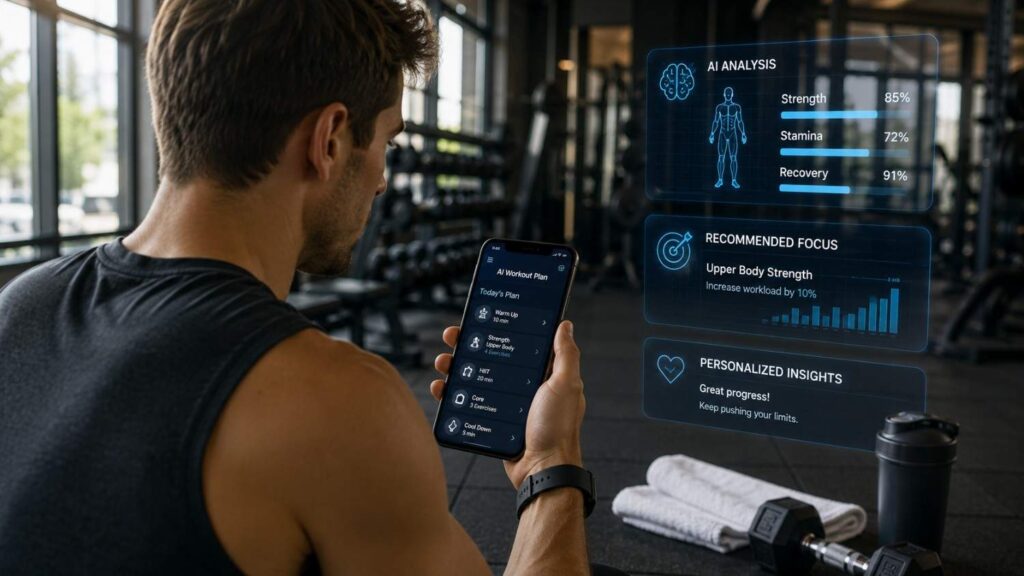
The Role of AI in Customizing Workout Plans
Artificial intelligence is changing the way people approach fitness planning. In the past, most individuals relied on printed routines, general workout videos, magazine programs, or standardized plans created for a broad audience. These resources could provide useful starting points, but they rarely accounted for differences in fitness experience, equipment, schedule, physical ability, personal preference, or recovery needs. As a result, many users followed plans that were either too difficult, too easy, impractical, or poorly matched to their goals.
AI-based fitness systems aim to solve this problem by using personal information to create more relevant workout recommendations. A user may provide a goal such as improving strength, building muscle, increasing cardiovascular fitness, losing body fat, becoming more active, or preparing for a sporting event. The system can then consider available training days, session length, accessible equipment, experience level, and exercise preferences before organizing a structured routine.
The most advanced systems do more than generate a one-time program. They can review completed workouts, compare planned and actual performance, identify missed sessions, and adjust future recommendations. Some AI-powered fitness applications also connect with wearable devices to analyse heart rate, movement, sleep estimates, and daily activity.
This level of customization can make fitness planning more accessible, efficient, and responsive. However, it also introduces important concerns. AI can produce confident recommendations without fully understanding pain, poor technique, medical history, or emotional fatigue. A useful AI-generated plan therefore requires accurate user input, conservative progression, ongoing feedback, and sensible human review.
The role of AI in customizing workout plans is not to remove personal responsibility or professional expertise. Its real value lies in making fitness information easier to organize, understand, and adapt.
What Does AI Workout Customization Actually Mean?
AI workout customization refers to the use of algorithms, machine learning models, fitness databases, and user-provided information to create exercise recommendations suited to an individual rather than a broad audience. The system may consider goals, experience, equipment, schedule, activity history, exercise preferences, physical restrictions, and completed workout data. It then uses these details to organize a program that is more relevant than a generic routine.
True customization involves more than inserting a person’s name into a standard template. A meaningful system should change the structure of the plan according to the information provided. For example, a beginner with resistance bands and 20 minutes per session requires a different program from an experienced gym user who trains five days each week. The number of exercises, training intensity, recovery time, and progression method should reflect those differences.
AI customization may also continue after the first plan is created. When users record completed sessions, perceived difficulty, pain, missed workouts, or changes in equipment, the program can update future recommendations. This creates an ongoing feedback loop in which the workout plan develops alongside the user.
However, not every application marketed as “AI-powered” offers the same depth of personalization. Some platforms use simple rule-based systems, while others use more complex machine learning techniques. Users should therefore evaluate whether a tool genuinely responds to individual data or merely selects from a limited collection of prewritten routines.
| User Data Input | How AI Uses It | Benefit to the Workout Plan |
|---|---|---|
| Fitness Goals | Selects suitable training style and exercises | Creates goal-specific workout plans |
| Training Experience | Adjusts workout difficulty and progression | Prevents overtraining or undertraining |
| Available Equipment | Chooses exercises based on accessible gear | Makes the plan practical and realistic |
| Weekly Schedule | Organizes workout frequency and session timing | Improves long-term consistency |
| Workout Performance | Evaluates completed sessions and progress | Updates future recommendations |
| Wearable Device Data | Monitors heart rate, activity, and recovery trends | Supports adaptive workout adjustments |
| User Preferences | Includes preferred exercises and training methods | Increases motivation and adherence |
| Recovery Feedback | Modifies intensity based on fatigue or soreness | Reduces unnecessary training stress |
The Difference Between Personalization and Automation
Automation and personalization are closely related, but they do not mean the same thing. Automation performs a task according to a fixed rule or predetermined sequence. For example, a fitness application may automatically unlock the second week of a program after the first week has been completed. It may also send a reminder at the same time every day or increase repetitions according to a fixed schedule. These features save time, but they do not necessarily reflect the user’s individual response.
Personalization requires the system to consider personal information before deciding what should happen next. If a user repeatedly struggles to finish a 45-minute session, a personalized system may reduce the number of exercises, shorten the workout, or divide the routine across additional days. If another user completes every session comfortably, the system may increase resistance, repetitions, or exercise complexity.
The distinction matters because a plan can be automated without being genuinely customized. A fixed 12-week program delivered through an app remains largely standardized even when reminders and progress charts are included.
Effective personalization should also consider preferences and practical circumstances. A technically correct plan may still fail if it requires unavailable equipment, includes disliked exercises, or conflicts with the user’s schedule. The best systems use automation to deliver personalized decisions efficiently rather than using automation as a substitute for individual planning.
What Information Can AI Use?
An AI workout planner can use several types of information to produce a more relevant program. The most basic inputs include age range, current fitness level, training experience, primary goal, available equipment, weekly availability, and preferred session length. These details help the system decide whether the plan should prioritize strength, endurance, mobility, general activity, or another training outcome.
Additional information may include exercise preferences, previous injuries, movements the user cannot perform comfortably, and the location where training will take place. A home workout plan may rely on bodyweight exercises, resistance bands, or dumbbells, while a gym-based plan can include machines, barbells, cables, and cardiovascular equipment.
After training begins, the system may collect performance data such as completed sets, repetitions, weights, running pace, workout duration, and perceived difficulty. Some applications also connect with wearable devices that record heart rate, steps, activity minutes, sleep estimates, and other biometric signals.
This information can improve recommendations, but only when it is accurate and interpreted correctly. Wearable readings may contain errors, while user-entered information may be incomplete. An algorithm may also struggle to determine why performance changed. Poor results could come from fatigue, stress, illness, incorrect technique, or insufficient motivation. AI can identify patterns, but it does not always understand the full context behind those patterns.
How Machine Learning Improves Recommendations
Machine learning allows a fitness system to identify patterns in user data and use those patterns to improve future recommendations. Instead of applying the same rules to everyone, the system can examine how a particular user responds to different types of training. Over time, it may recognize that the person performs better with shorter sessions, needs additional recovery after high-intensity exercise, or progresses more consistently when difficulty increases gradually.
For example, a user may repeatedly complete strength workouts but skip long cardiovascular sessions. A machine learning system could identify this pattern and recommend shorter interval sessions, different activities, or a revised weekly schedule. Similarly, if a user regularly reports high difficulty after a particular exercise, the system may reduce the weight, change the repetition range, or suggest an alternative movement.
Machine learning can also help compare current performance with previous results. This allows the program to identify plateaus, improvements, inconsistent attendance, or unusual declines in performance.
However, machine learning is only as useful as the data available to it. Incomplete workout records, inaccurate wearable readings, or unclear feedback can produce weak recommendations. The system may also identify a correlation without understanding its true cause. Human review remains important when the change involves pain, medical symptoms, major performance decline, or unusually demanding progression.
How AI Creates a Personalized Workout Plan
AI creates a personalized workout plan by combining user information with exercise-selection rules, training principles, performance data, and ongoing feedback. The process normally begins with an assessment. The system asks questions about the user’s goals, fitness experience, available equipment, preferred activities, schedule, and physical limitations. These answers establish the boundaries within which the program should operate.
The next stage is program construction. The system selects exercises and organizes them into sessions according to the user’s objective. A strength-focused plan may prioritize resistance exercises and gradual increases in training load. A cardiovascular plan may focus on frequency, duration, intensity, and activity type. A general fitness plan may combine resistance training, aerobic activity, mobility, and recovery.
A well-designed AI system should also determine how the program will progress. Progression may involve adding repetitions, increasing resistance, extending exercise duration, reducing rest periods, or introducing more complex movements. These changes should occur gradually and should reflect the user’s actual performance.
The final stage is adaptation. Once the user begins training, the system can compare planned sessions with completed activity. It may adjust the following week if workouts were missed, exercises felt too difficult, recovery appeared inadequate, or progress was faster than expected.
This process can make fitness planning more responsive, but it is not automatically reliable. The quality of the outcome depends on the questions asked, the training principles used, the accuracy of feedback, and the system’s ability to avoid unsafe or unrealistic recommendations.
Step One: Establishing a Fitness Baseline
The first step in creating a personalized workout plan is establishing a realistic fitness baseline. This baseline describes where the user is starting rather than where the user hopes to be. Without it, an AI system may produce recommendations that are unnecessarily difficult, too basic, or poorly matched to the person’s actual ability.
A useful baseline assessment should include training experience, recent activity level, available equipment, session duration, weekly availability, exercise preferences, and relevant physical restrictions. The system should also ask whether the user can comfortably perform common movement patterns such as squatting, pushing, pulling, bending, carrying, walking, or running.
The primary fitness goal must be specific enough to guide program design. “Getting fit” is broad, while “building basic strength with three 40-minute home workouts per week” provides clearer direction. The AI should also distinguish between short-term preferences and long-term objectives.
One thing I always check first is whether the tool asks enough questions before generating a routine. A system that immediately creates a plan from a single goal is more likely to provide generic recommendations.
Users should answer baseline questions honestly. Overstating experience or ignoring physical limitations can lead to unsuitable exercise selection. When the baseline is accurate, the AI has a stronger foundation for choosing appropriate intensity, volume, exercise complexity, and progression.
Step Two: Structuring the Training Program
After establishing a baseline, the AI must organize the program into a practical weekly structure. This involves deciding how often the user should train, how long each session should last, which exercise types should be included, and how demanding the sessions should be. A useful plan must fit the user’s real schedule rather than an ideal schedule that will be difficult to maintain.
The system may use established training variables such as frequency, intensity, time, type, volume, and progression. Frequency describes how often training occurs. Intensity reflects how demanding the activity is. Time refers to session duration, while type identifies the form of exercise. Volume represents the total amount of work, and progression explains how the challenge will increase over time.
A structured weekly plan may contain training days, recovery days, exercise order, sets, repetitions, rest periods, warm-ups, cool-downs, and progression instructions. It should also explain how the plan supports the user’s goal.
For example, a beginner strength program may include two or three full-body sessions rather than dividing every muscle group into separate days. A busy user may receive shorter sessions with fewer exercises, while an experienced athlete may require more specialized programming.
The program should remain understandable. Excessive complexity can reduce adherence, even when the underlying recommendations are technically reasonable.
Step Three: Adjusting the Plan Over Time
A personalized workout plan becomes more valuable when it changes according to actual performance. After each session or training week, the system can review what the user completed, what felt difficult, which exercises were skipped, and whether the planned schedule remained realistic. This feedback allows the program to evolve instead of remaining fixed.
An AI system may reduce training volume after several incomplete sessions, add repetitions when an exercise becomes consistently easy, or replace a movement that causes discomfort. It may also move demanding workouts away from busy days, shorten sessions during travel, or schedule additional recovery after unusually high activity.
Progression should be gradual. Increasing weight, repetitions, duration, and frequency at the same time may create excessive fatigue. A sensible system should normally adjust one or two variables while keeping the rest of the program stable. This makes it easier to evaluate whether the change was effective.
Users should also understand that not every poor workout requires an immediate program change. Temporary stress, lack of sleep, illness, or an unusually demanding day can reduce performance. Constantly rewriting the routine may prevent the user from developing consistency.
AI should identify meaningful patterns across several sessions rather than reacting aggressively to a single result. Human judgment is especially important when performance declines sharply, pain appears, or recovery remains poor for an extended period.
Benefits of AI-Powered Fitness Planning
AI-powered fitness planning offers several practical advantages, particularly for users who need structure but cannot access regular personal coaching. The technology can convert broad goals into organized routines, provide exercise alternatives, track performance, and update recommendations when circumstances change. This reduces the amount of manual planning required from the user.
One important benefit is accessibility. AI fitness tools are usually available at any time, making them useful for people with unpredictable schedules, limited access to gyms, or difficulty arranging appointments with a trainer. A user can request a shorter workout, replace an unavailable exercise, or reorganize a training week without waiting for a scheduled consultation.
AI can also support consistency. Many people struggle not because they dislike exercise, but because they are unsure what to do, how much to do, or when to progress. A structured AI workout planner can reduce this uncertainty by presenting clear daily actions and recording completed sessions.
Another benefit is responsiveness. Traditional workout templates may remain unchanged for several weeks even when the user’s schedule, equipment, or performance changes. AI can modify the plan more quickly.
However, these benefits should be viewed realistically. AI does not guarantee motivation, accurate technique, safe progression, or measurable results. It is a tool for organizing information and improving decision-making. Its effectiveness still depends on user effort, consistency, recovery, nutrition, and appropriate professional guidance when needed.
Greater Accessibility and Convenience
AI-powered fitness tools can make basic workout planning available to people who may not have regular access to a personal trainer. Cost, location, working hours, family responsibilities, and transportation can all make traditional coaching difficult. A mobile fitness application or online AI workout planner can offer guidance at almost any time and from almost any location.
This convenience is especially valuable for users who train at home, travel frequently, or have changing schedules. If a person unexpectedly loses access to a gym, the system can replace machine-based exercises with bodyweight, resistance-band, or dumbbell alternatives. If only 20 minutes are available, the application may reduce the session while preserving its main purpose.
AI can also make fitness planning less intimidating for beginners. Instead of searching through hundreds of exercises, the user can receive a structured starting point based on stated goals and available equipment. Clear instructions can reduce confusion and help users understand how different activities fit together.
Convenience should not be confused with complete professional support. An AI application may be easily accessible, but it cannot always observe movement quality or understand the reasons behind pain and fatigue. The strongest use of AI is to make general planning and adjustment more convenient while directing users toward qualified professionals when the situation falls outside ordinary fitness guidance.
Better Consistency and Progress Tracking
Consistency is one of the most important factors in long-term fitness improvement, yet it is also one of the most difficult habits to maintain. AI fitness coaching can support consistency by providing a clear schedule, recording completed sessions, displaying progress, and reminding users what to do next. This reduces the decision-making burden that often causes people to delay or skip workouts.
Progress tracking may include repetitions, resistance, duration, distance, pace, heart rate, workout frequency, and perceived difficulty. When this information is displayed over time, users can see improvements that may not be obvious from day to day. A person may notice that the same exercise is being performed with greater resistance, that walking pace has improved, or that weekly attendance has become more reliable.
AI can also identify patterns in missed workouts. If a user regularly skips evening sessions, the system may recommend training earlier or reducing session length. If performance improves after additional rest, future scheduling may reflect that pattern.
However, progress data must be interpreted carefully. Weight, heart rate, calorie estimates, and recovery scores can fluctuate for many reasons. A useful AI system should focus on trends rather than isolated numbers.
The main advantage is not that the technology guarantees results. It is that clearer feedback can help users understand their behaviour, maintain direction, and make more informed adjustments.
Faster Program Modification
One of the strongest advantages of AI fitness planning is the ability to modify a program quickly. Traditional workout plans are often created as fixed documents or spreadsheets. When a user’s schedule, equipment, fitness goal, or physical ability changes, those plans may require substantial manual revision. An AI system can generate alternatives within seconds.
For example, a user may need to replace a barbell exercise with dumbbells, convert a gym session into a home workout, shorten a 60-minute routine to 30 minutes, or reorganize training around travel. The system can review the original purpose of the session and suggest replacements that target similar movement patterns or energy systems.
Rapid modification is also useful when an exercise is too difficult or no longer challenging. The AI may provide easier variations, increase repetitions, change tempo, adjust rest periods, or recommend a more advanced progression.
In my experience, this is where AI offers significant practical value. It allows users to explore options without rebuilding an entire plan from the beginning.
Speed, however, does not guarantee quality. A replacement exercise may use similar muscles but require different technique or place different demands on the body. Users should review every modification and avoid accepting sudden increases in difficulty simply because the system presents them confidently. Fast adjustments should remain logical, gradual, and consistent with the original training goal.
AI Personal Trainer vs. Human Personal Trainer
AI personal trainers and human personal trainers can both support fitness planning, but they offer different types of value. AI is strong at organizing information, processing recorded data, generating exercise alternatives, and providing immediate responses. Human trainers are stronger at observing movement, interpreting behaviour, understanding unclear feedback, and applying professional judgment in complex situations.
An AI system can remain available at any time and may cost less than regular one-to-one coaching. It can store detailed workout records, identify patterns, and produce rapid program changes. These features make it useful for users who already understand basic exercise technique and need help with structure, variety, or progress tracking.
A human trainer can observe posture, control, range of motion, balance, breathing, and confidence. These details may not appear in workout data. A trainer can also ask follow-up questions when a user says that an exercise “doesn’t feel right,” helping distinguish ordinary effort from poor technique or potential injury.
The comparison should not be framed as a competition in which one option must replace the other. The most suitable choice depends on the user’s experience, budget, goals, health, and need for supervision.
For many people, a hybrid approach provides the strongest balance. AI can handle routine planning and record-keeping, while a qualified professional reviews technique, confirms suitability, and provides deeper guidance when problems arise.
Where AI Performs Well
AI performs particularly well when working with structured information. It can collect user preferences, organize weekly schedules, record completed workouts, compare current and previous results, and generate alternatives based on available equipment. These tasks require speed, consistency, and data processing rather than direct physical observation.
An AI personal trainer can also provide immediate support. A user does not need to wait for an appointment to ask for a shorter workout, replace an exercise, or adjust the next training week. This makes the technology useful for users with changing routines or limited access to in-person coaching.
Another strength is detailed record-keeping. The system may remember previous weights, repetitions, distances, workout durations, and reported difficulty. It can use this information to recommend gradual progression and highlight long-term patterns.
AI can also explain common fitness concepts in simple language. Users may ask about progressive overload, rest periods, exercise order, or the difference between strength and endurance training.
The technology is most effective when the question is clear and the required information is available. It performs less reliably when the situation depends on visual assessment, medical judgment, emotional understanding, or incomplete feedback. AI should therefore be used for tasks that suit data-driven decision-making rather than as a universal replacement for professional expertise.
Where Human Coaches Remain Stronger
Human trainers remain stronger in areas that require observation, communication, empathy, and contextual judgment. During an in-person or live video session, a trainer can watch how a user performs an exercise and identify problems with balance, posture, control, breathing, range of motion, or movement speed. These details are difficult for a text-based AI system to evaluate.
A human coach can also respond to unclear or emotional feedback. If a client appears anxious, discouraged, distracted, or unusually tired, the trainer can ask questions and adjust the session accordingly. Motivation is not only about sending reminders. It often requires understanding why a person is struggling and choosing an appropriate response.
Professional trainers can make more informed decisions when goals are complex. Preparing for competition, returning from injury, managing significant movement limitations, or coordinating exercise with medical care may require expertise beyond general fitness programming.
A qualified coach also understands professional boundaries. When symptoms suggest a medical issue, the trainer can refer the client to a healthcare provider rather than attempting to diagnose the problem.
AI may generate a confident answer even when important context is missing. Human trainers are better able to recognize uncertainty and gather additional information. This ability to interpret the complete situation remains one of the clearest advantages of professional coaching.
Why a Hybrid Approach Is Often Best
A hybrid approach combines the efficiency of artificial intelligence with the observation and judgment of a human professional. Instead of expecting one system to handle every part of fitness coaching, the user assigns different responsibilities according to their strengths.
AI can organize training schedules, maintain workout records, suggest exercise alternatives, analyse performance trends, and generate routine adjustments. These tasks can reduce administrative work and allow the user or trainer to focus on decisions that require deeper understanding.
A human coach can review the AI-generated plan, confirm that the exercises are appropriate, teach correct technique, and adjust recommendations based on real-world observations. Periodic professional sessions may be enough for some users, especially when they already train independently but want guidance at important stages.
For example, a beginner could meet with a trainer to learn major movement patterns and then use an AI workout planner for weekly organization. The trainer could review progress monthly and address technique problems. An experienced athlete might use AI to track training data while relying on a coach for competition planning and performance analysis.
I recommend the hybrid model for beginners, older adults, athletes, and anyone returning after an injury. It provides convenience without removing professional oversight. The goal is not to use more technology, but to use each resource where it contributes the greatest value.
Safety, Privacy and Limitations of AI Workout Plans
AI workout plans can be useful, but they should never be followed without critical review. The system may create recommendations based on incomplete information, misunderstand physical limitations, or fail to recognize when symptoms require professional attention. Users must understand that a personalized interface does not automatically mean the plan is medically appropriate or professionally supervised.
One major limitation is the absence of direct physical assessment. A text-based system cannot reliably observe movement quality, joint control, balance, breathing, posture, or signs of discomfort. Even video-based technology may misinterpret movement because of camera position, clothing, lighting, or limited analysis.
Another concern is data accuracy. Wearable devices estimate heart rate, sleep, calories, recovery, and activity, but these measurements are not always exact. If an AI system treats every estimate as reliable, its recommendations may become misleading.
Privacy also matters because fitness platforms can collect sensitive information about activity habits, location, sleep, heart rate, body measurements, and daily routines. Users should understand what data is collected, how long it is stored, and whether it is shared.
AI is most appropriate for general fitness planning among users who can exercise safely and understand their limitations. Medical conditions, pregnancy, rehabilitation, severe pain, and unexplained symptoms require individualized guidance from an appropriately qualified professional.
When AI Fitness Advice May Be Unsafe
AI fitness advice may become unsafe when the system receives incomplete information or when the user relies on it for situations requiring medical or professional assessment. A person may forget to mention an injury, overestimate current fitness, or select an advanced experience level to receive a more challenging program. The AI may then recommend movements or training volumes that are inappropriate.
Automated systems can also struggle to interpret pain. They may treat discomfort as ordinary exercise difficulty, recommend a simple modification, or encourage continued training without understanding the underlying cause. Pain that is sharp, sudden, severe, or accompanied by weakness, swelling, dizziness, chest discomfort, or unusual breathlessness should not be managed through automated workout advice.
People with diagnosed cardiovascular conditions, uncontrolled blood pressure, significant joint problems, neurological conditions, recent surgery, or active injuries should seek appropriate professional guidance before beginning a new program. Pregnancy and postnatal exercise may also require individualized assessment.
Users should stop exercising and seek suitable medical attention if unusual or serious symptoms appear. AI cannot diagnose the reason for those symptoms.
The safest approach is to use AI for general planning within known personal limits. Recommendations should progress gradually, include recovery, and remain easy to modify. When uncertainty exists, professional advice is more appropriate than asking the system to generate another routine.
Fitness Tools Are Not Automatically Medical Devices
A fitness application may look advanced, use medical-sounding language, and process biometric information without being a regulated medical device. Many wellness platforms are designed to support general activity, exercise habits, sleep awareness, or lifestyle improvement. They are not necessarily approved to diagnose, treat, prevent, or monitor a medical condition.
This distinction is important because users may assume that an AI-powered recommendation has been clinically validated. In reality, the application may rely on general exercise databases, user-entered information, or automated language generation. A professional-looking dashboard does not confirm that the advice is medically suitable.
Before relying on a platform, users should review its stated purpose, evidence, qualifications, and limitations. The company should explain whether the product is designed for general wellness, fitness coaching, rehabilitation support, or clinical use. It should also clarify whether healthcare professionals contributed to the program.
Medical claims require stronger evidence than general fitness recommendations. A tool that promises to diagnose injuries, treat chronic disease, or replace medical care should be examined carefully.
AI fitness applications can still be valuable without being medical devices. They may help healthy users organize exercise, improve consistency, and track progress. The problem begins when general wellness guidance is treated as clinical advice. Users should match the tool to the type of decision they are making.
Personal Data and Privacy Concerns
AI fitness platforms may collect more information than users initially realize. Depending on the application, stored data may include age, body measurements, exercise history, location, heart rate, sleep estimates, menstrual-cycle information, workout schedules, health goals, and connected-device records. Together, these details can reveal sensitive patterns about a person’s daily life.
Before connecting a smartwatch, health account, or location service, users should review the platform’s privacy policy and permission settings. They should understand what information is required, what is optional, why the data is collected, and whether it is shared with advertisers, analytics providers, or other third parties.
Users should also check whether information can be downloaded, corrected, or permanently deleted. Strong account security, encrypted data transfer, and multi-factor authentication can provide additional protection.
Only necessary information should be shared. A general workout planner may need training experience and equipment access, but it may not require detailed medical records. Users should avoid entering unrelated personal or medical information into a general-purpose generative AI system.
Privacy decisions should be revisited when the application updates its policies or introduces new features. Convenience should not lead users to grant unlimited access without understanding the consequences. Personalized fitness guidance can be useful, but users should remain in control of the information that makes personalization possible.
How to Use AI to Create a Better Workout Plan
Creating a useful AI workout plan requires more than entering a short request such as “make me a fitness routine.” The system needs specific, accurate, and practical information. The clearer the input, the more likely the recommendations will match the user’s goals, experience, equipment, and schedule.
The first step is to define the objective. Strength development, muscle growth, cardiovascular fitness, mobility, general health, and sports preparation require different program structures. Users should then explain their current ability rather than describing the ability they hope to achieve.
Available equipment and time must also be stated clearly. A plan designed for a fully equipped gym will not help someone training in a small room with resistance bands. Similarly, a five-day program is not useful when the person can realistically train only three times per week.
After receiving the initial plan, the user should review every exercise, session length, progression method, and recovery recommendation. Any unfamiliar movement should be researched through reliable demonstrations or discussed with a qualified trainer.
The plan should then be updated using real feedback. Completed exercises, difficulty, missed sessions, soreness, and schedule changes help the AI make better adjustments.
AI works best when it supports an ongoing planning process. The user remains responsible for checking whether the plan is safe, realistic, understandable, and compatible with personal circumstances.
| Best Practice | Why It Matters |
|---|---|
| Enter accurate fitness information | Helps AI generate realistic recommendations |
| Clearly define your primary goal | Aligns workouts with desired outcomes |
| Update progress every week | Allows AI to refine future workout plans |
| Report fatigue or soreness honestly | Prevents excessive training intensity |
| Review recommendations before starting | Identifies unrealistic or unsafe exercises |
| Keep workout expectations realistic | Supports gradual and sustainable progress |
| Use wearable data when available | Provides additional performance insights |
| Combine AI guidance with professional advice when needed | Improves safety for injuries and complex fitness goals |
Provide a Complete Fitness Profile
A complete fitness profile gives the AI enough context to create a relevant starting plan. Begin by stating one clear primary goal. Examples include improving general strength, becoming more active, increasing running endurance, building muscle, or preparing for a specific event. Multiple goals can be included, but the main priority should be identified.
Next, describe current training experience. Include how often you exercise, which activities you perform, and whether you are comfortable with basic movement patterns. Avoid describing yourself as intermediate or advanced without explaining what that means in practice.
List all available equipment, including bodyweight-only options, resistance bands, dumbbells, machines, or cardio equipment. State where training will occur and how much space is available.
Provide a realistic schedule. Include the number of days, preferred training times, and maximum session length. Mention exercises you enjoy, activities you dislike, and movements you cannot perform comfortably.
A detailed request may say:
“Create a three-day beginner strength program for general fitness. I can train for 40 minutes at home using adjustable dumbbells, resistance bands, and a bench. Include a warm-up, sets, repetitions, rest periods, easier alternatives, and a four-week progression method.”
The quality of the profile influences the quality of the plan. Missing information forces the system to make assumptions that may not suit the user.
Give Feedback After Every Training Week
AI personalization improves when the user provides specific feedback after completing several workouts. General comments such as “the plan was fine” or “the workout was difficult” do not explain what should change. Detailed feedback allows the system to identify patterns and make more appropriate adjustments.
Record which sessions were completed, skipped, shortened, or modified. Include the exercises performed, actual sets and repetitions, resistance used, session duration, and perceived difficulty. Mention whether a movement felt comfortable, unstable, confusing, or painful.
Users should also report practical problems. A workout may be effective in theory but too long for the available schedule. Equipment may be unavailable, or the training order may create unnecessary delays in a busy gym.
Recovery information can provide useful context. Report unusual soreness, poor sleep, low motivation, or fatigue that affected performance. However, users should not expect the AI to diagnose the cause of these changes.
Ask the system to make only a small number of adjustments at one time. Changing every exercise and training variable can make it difficult to determine what improved the program.
Weekly feedback does not mean the entire routine must be rewritten each week. Consistency remains important. The purpose of feedback is to refine the plan gradually while preserving enough stability to measure progress.
Apply a Human Safety Check
Every AI-generated workout plan should pass a human safety check before it is followed. Begin by reviewing whether the exercises match the user’s experience and equipment. A beginner plan should not depend on complex movements that require advanced coordination or supervision without offering simpler alternatives.
Check how quickly the program increases difficulty. Progression should usually occur gradually through small changes in repetitions, resistance, duration, or exercise complexity. A plan that increases several variables at once may create unnecessary fatigue.
Recovery must also be included. The schedule should contain appropriate rest days or lighter sessions, particularly when the workouts are demanding. More training is not always better, and constant high-intensity activity can reduce consistency.
Review every exercise for pain or discomfort. Normal muscular effort is different from sharp, sudden, or unusual pain. The plan should never encourage the user to ignore concerning symptoms.
Confirm that the AI is not making medical claims or attempting to diagnose an injury. Health conditions and rehabilitation needs should be discussed with an appropriate professional.
Finally, check whether the program is realistic. A safe plan must fit the user’s available time, environment, ability, and recovery capacity. AI should make fitness planning easier, but the final decision must remain with the user and, where necessary, a qualified human expert.
Quick Answer About The Role of AI in Customizing Workout Plans
The role of AI in customizing workout plans is to transform personal information into exercise recommendations that can change as the user’s needs, schedule, performance, and fitness level develop. An AI workout planner may analyse goals, training history, available equipment, preferred activities, session duration, completed exercises, and user-reported fatigue. Some advanced platforms can also process information from smartwatches and fitness trackers, including heart rate, daily activity, estimated sleep, and recovery indicators.
Using these inputs, the system can recommend suitable exercises, organize weekly sessions, adjust repetitions or intensity, and replace movements that do not fit the user’s circumstances. This makes an adaptive workout plan more flexible than a generic routine downloaded from the internet.
However, AI should not be treated as an unquestionable fitness authority. It cannot always identify incorrect technique, diagnose an injury, understand the cause of unusual pain, or interpret emotional and physical fatigue accurately. Wearable information can also be incomplete or misleading. For these reasons, AI is most valuable as a planning, tracking, and decision-support tool.
A qualified trainer, exercise professional, physiotherapist, or healthcare provider may still be necessary when a user has a medical condition, an active injury, complex movement limitations, or advanced performance goals. The most responsible approach is to combine AI efficiency with human judgment.
Frequently Asked Questions
AI-based workout planning raises practical questions about personalization, safety, effectiveness, privacy, and professional oversight. Users often want to know whether an algorithm can understand their fitness level, how often the program should change, and whether wearable-device information improves the recommendations.
The answers depend partly on the type of system being used. Some applications follow simple rules and select from existing workout templates. More advanced platforms may analyse training history, performance trends, user feedback, and wearable data. Generative AI tools can also create routines from written instructions, but their recommendations may vary depending on how the request is phrased.
Regardless of the technology, users should remember that personalization has limits. AI can organize known information, but it cannot always identify missing information or understand physical sensations accurately. It may produce an answer that sounds confident even when the available context is incomplete.
The following FAQs address the most common search questions associated with the role of AI in customizing workout plans. Each answer focuses on realistic benefits while maintaining appropriate safety boundaries. These explanations are intended for general educational purposes and should not replace medical diagnosis, rehabilitation advice, or individualized professional supervision.
How does AI personalize a workout plan?
AI personalizes a workout plan by analysing information about the user and matching that information with exercise-selection and program-design rules. Typical inputs include fitness goals, training experience, available equipment, weekly schedule, preferred activities, session length, and physical restrictions entered by the user.
After the program begins, the system may review completed sessions, repetitions, resistance, duration, perceived difficulty, and missed workouts. Advanced applications may also use data from smartwatches or fitness trackers, such as heart rate, activity, sleep estimates, and recovery indicators.
The AI then uses this information to select exercises, organize training days, recommend intensity, and suggest progression. It may shorten a workout when time is limited, replace an unavailable exercise, or reduce training volume after repeated difficulty.
Personalization does not mean the system understands everything about the user. AI cannot always identify poor technique, emotional stress, illness, or the cause of pain. The plan is only as accurate as the information provided and the quality of the underlying system. Users should review recommendations and seek qualified guidance when the situation involves medical conditions, injury, or complex performance goals.
Can an AI workout plan help beginners?
An AI workout plan can help beginners by turning a broad fitness goal into a clear and manageable weekly routine. Many new exercisers struggle because they do not know which exercises to choose, how many sessions to complete, how long to train, or when to increase difficulty. AI can provide a structured starting point based on available time, equipment, and stated preferences.
A beginner-focused plan may include basic movement patterns, simple instructions, conservative training volume, rest periods, and gradual progression. It can also provide easier alternatives when an exercise is too difficult or when equipment is unavailable.
However, beginners often need more than a written program. Correct exercise technique, breathing, posture, and movement control can be difficult to learn from text alone. Reliable instructional videos or guidance from a qualified trainer may be necessary.
The plan should not become more difficult too quickly. Beginners need time to learn movements, build confidence, and adapt to regular activity.
AI is therefore useful as an organizational and educational tool, but it should not be treated as a substitute for all forms of supervision. A simple, consistent, and safely performed program is more valuable than a complex routine generated to appear highly personalized.
Are AI-generated workouts safe?
AI-generated workouts can be reasonably safe for general fitness when the user provides accurate information, chooses an appropriate difficulty level, and carefully reviews the recommendations. Many systems can create basic routines using common exercises and established training principles.
Safety becomes more uncertain when the user has an injury, medical condition, significant movement limitation, or little understanding of exercise technique. AI cannot physically examine the user, reliably diagnose pain, or always distinguish ordinary muscular effort from a potentially serious problem.
The system may also recommend excessive volume or progression when the input is incomplete. A person who overstates fitness experience may receive a plan that is too demanding. Wearable data can also be inaccurate or misinterpreted.
Users should begin conservatively, learn proper technique, include recovery, and stop exercising when severe or unusual symptoms occur. Sudden pain, chest discomfort, faintness, weakness, or unusual shortness of breath requires appropriate professional attention.
AI-generated workouts are best treated as suggestions rather than instructions that must be followed exactly. A qualified trainer or healthcare professional should review the plan when the user’s health, injury history, or physical ability creates additional risk.
Can AI replace a personal trainer?
AI can replace some tasks traditionally handled by a personal trainer, but it cannot fully replace professional human coaching. It performs well at generating workout schedules, suggesting exercise alternatives, recording training data, identifying patterns, and providing immediate responses. These features may be enough for experienced users who understand technique and need basic planning support.
A human trainer offers capabilities that AI does not consistently provide. Trainers can observe movement, correct technique, identify hesitation, ask follow-up questions, and adjust a session according to behaviour that may never appear in recorded data. They can also provide personal accountability, empathy, and motivation.
Professional judgment becomes particularly important when a user has pain, a medical condition, an injury, or advanced performance goals. AI may offer a confident recommendation without recognizing that important context is missing.
For many people, the best solution is not choosing one option exclusively. AI can manage routine planning and progress tracking, while a trainer provides periodic assessments, technique instruction, and complex decision-making.
The appropriate balance depends on experience, budget, goals, and risk. AI is a valuable fitness assistant, but human professionals remain important whenever direct observation and individualized judgment are required.
How often should an AI workout plan change?
An AI workout plan should change when there is a clear reason, not simply because the technology can generate a new routine. Users need enough consistency to learn exercises, improve technique, and measure progress. Changing the entire program every few days may make training less effective and more confusing.
Small adjustments can be made weekly when performance data supports them. The system may add repetitions, slightly increase resistance, shorten a session, replace an unavailable exercise, or reorganize training days. These changes should normally be gradual.
Larger changes may be appropriate after several weeks, when the user’s goal changes, progress stalls, equipment becomes unavailable, or the original schedule no longer fits daily life. A significant decline in performance may also require review, although the cause should be considered before changing the program.
Not every difficult session requires immediate modification. Sleep, stress, nutrition, illness, and daily activity can temporarily affect performance.
A useful AI system should look for trends across multiple workouts rather than reacting aggressively to a single result. The purpose of customization is to improve relevance, not create constant variety. Stable training with thoughtful adjustments is usually more effective than repeatedly replacing exercises without a clear reason.
Does AI need wearable-device data?
AI does not need wearable-device data to create a personalized workout plan. A useful routine can be developed from manually entered information such as fitness goals, training experience, available equipment, weekly schedule, preferred activities, and completed workout results.
Wearable data can add another layer of information. Smartwatches and fitness trackers may provide estimates of heart rate, steps, activity duration, sleep, energy expenditure, and recovery. An AI system may use these signals to identify patterns or suggest changes in training demand.
However, wearable information does not automatically make recommendations accurate. Consumer devices use different sensors and calculation methods, and their estimates can vary. Sleep stages, calorie expenditure, and recovery scores should be treated as indicators rather than perfect measurements.
Users should also consider privacy before connecting a device. The platform may gain access to detailed activity and health-related information.
Wearable data is most useful when combined with personal feedback and actual workout performance. A low recovery score should not automatically cancel a session, just as a high score should not justify excessive intensity.
AI can function without wearables, and many users may prefer to enter only the information necessary for planning. The value of connected data depends on accuracy, interpretation, and responsible use.
What is the biggest limitation of an AI personal trainer?
The biggest limitation of an AI personal trainer is incomplete context. The system can process the information it receives, but it cannot always recognize what is missing or understand why a user’s performance has changed. A decline may result from poor sleep, emotional stress, illness, incorrect technique, inadequate nutrition, excessive activity, or a developing injury.
AI may identify that repetitions decreased, but it may not understand the reason. It can suggest a lighter workout, yet it cannot physically assess the user or observe subtle changes in movement.
Another limitation is confidence. Generative AI systems may present recommendations in a clear and authoritative style even when the evidence is uncertain or the input is incomplete. Users may therefore overestimate the reliability of the advice.
AI also lacks genuine empathy and cannot provide the same level of accountability or emotional understanding as a human coach. Automated encouragement may help, but it does not fully respond to individual fears, frustration, or motivation.
These limitations do not make AI useless. They define how it should be used. AI is strongest as a planning, tracking, and educational assistant. Important decisions involving pain, health, rehabilitation, technique, or advanced performance should remain under qualified human supervision.
Conclusion
The Role of AI in Customizing Workout Plans is becoming increasingly important as fitness applications, wearable devices, machine learning systems, and generative AI tools become more accessible. These technologies can transform personal information into structured exercise recommendations, helping users understand what to do, when to train, and how to adjust their routines over time.
AI is particularly valuable for organizing schedules, selecting exercises, providing alternatives, tracking progress, and responding to changes in equipment or availability. It can reduce the uncertainty that often prevents beginners from starting and can save experienced users time when they need to modify an existing program.
Its limitations are equally important. AI cannot always observe movement quality, interpret pain, understand emotional fatigue, or identify medical risk. Wearable data may be inaccurate, and user-provided information may be incomplete. A plan that appears highly personalized can still be unsuitable if the underlying assumptions are wrong.
The most responsible approach is to use AI as a flexible planning assistant rather than an unquestionable authority. Users should provide accurate information, begin conservatively, track real performance, and review every adjustment. Gradual progression, adequate recovery, proper technique, and personal safety must remain central to the program.
Qualified trainers and healthcare professionals continue to play an essential role in movement assessment, rehabilitation, medical guidance, and advanced performance planning. When AI efficiency is combined with informed human judgment, users can benefit from more accessible, adaptable, and practical workout planning.