
The Future of Smart Mirrors in Fitness: How AI Is Changing Home Workouts
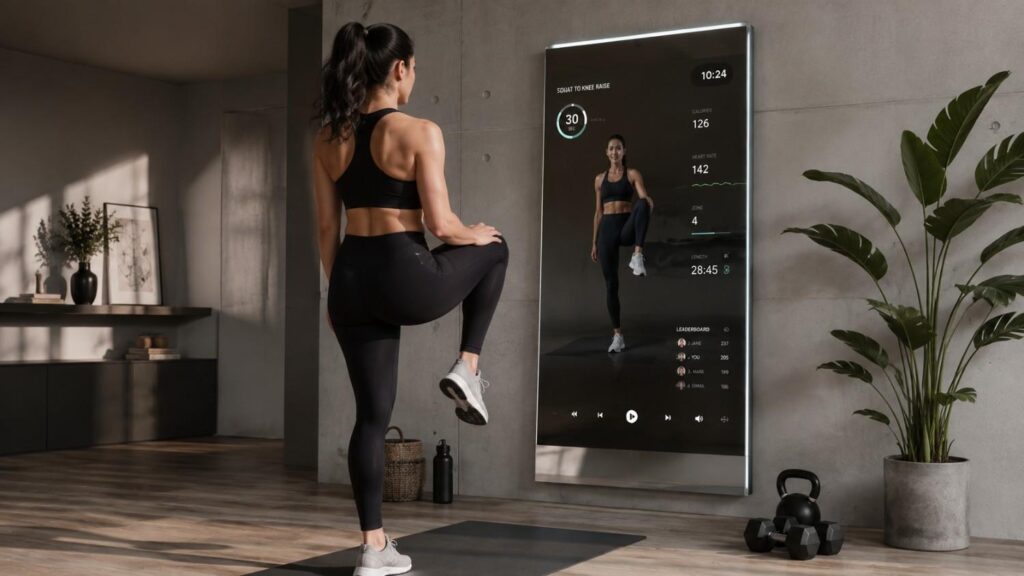
The Future of Smart Mirrors in Fitness is becoming much more ambitious than simply hiding a display behind reflective glass. The emerging vision is a home-training platform capable of observing movement, organizing fitness data, adapting workout recommendations, connecting with other devices, and making digital coaching feel more responsive to the individual.
That direction reflects wider changes in the fitness industry. Wearable technology remains particularly influential. The American College of Sports Medicine’s worldwide fitness trends report placed wearables first for 2026, while mobile exercise applications also remained prominent. ACSM notes that connected devices increasingly give users access to real-time and long-term fitness information, although it also cautions that the accuracy and usefulness of individual metrics can vary.
At the same time, the history of connected fitness shows why technological novelty is not enough. lululemon stopped selling its Studio Mirror hardware in 2023 as part of a broader strategic change involving Peloton. Existing customers continued receiving support, but the decision demonstrated a crucial reality: consumers purchasing connected hardware are also depending on the company, software platform, content library, and subscription model behind it.
The most successful future fitness mirrors will therefore need to deliver meaningful training value rather than simply impressive demonstrations. Artificial intelligence, computer vision, wearable integration, remote coaching, strong privacy controls, and durable software support could turn these products into serious home-fitness platforms. The sections below explain how that transformation is already beginning and where the technology could realistically go next.
How Are Smart Fitness Mirrors Evolving?
Smart fitness mirrors are evolving from content-delivery devices into interactive training systems. Early connected mirrors were attractive partly because they solved a straightforward home-fitness problem: a user could follow an instructor on a screen while simultaneously seeing their own reflection. That format made yoga, mobility, strength, dance, and other guided sessions easier to follow without permanently dedicating floor space to a large television or bulky machine.
The limitation was that traditional streaming remained mostly one-directional. The instructor delivered a workout, but the software typically knew relatively little about how the individual user was actually performing each movement. The next generation is attempting to close that gap by adding cameras, computer vision, movement tracking, personalized programming, performance analytics, and remote coaching.
For additional industry context, this overview of the fitness mirror market evolution explains how the category has progressed from simple connected displays to AI-driven training platforms.
Current products provide useful evidence of this transition. MAGIC AI markets a mirror using its ReflectAI technology for features such as real-time form feedback, rep counting, performance-based weight guidance, progress tracking, and personalized workout plans. FORME Studio emphasizes expert-led classes, structured programs, and live personal coaching through a connected wall-mounted display.
These are different strategies, but both point toward the same broader change: the screen is becoming only the interface. The real competitive value increasingly sits in the intelligence and service surrounding it.
As this technology develops, users should expect smart mirrors to be judged less by display quality or workout-library size and more by whether they can understand the user, adapt training intelligently, provide useful feedback, connect to other fitness data, and continue delivering value after the novelty of the hardware disappears.
From Streaming Workout Classes to Interactive Coaching
Traditional streaming fitness is primarily built around content choice. A user chooses a cycling, strength, yoga, Pilates, mobility, or HIIT class and follows the instructor. That model can be highly effective, but the workout itself usually remains largely unchanged regardless of whether the participant is a beginner, an experienced athlete, tired from yesterday’s training, or struggling with a particular movement.
Interactive coaching adds a feedback loop. Instead of merely showing what to do, the platform gathers information about what the user actually does. MAGIC AI currently advertises live repetition counting, form feedback, pace tracking, weight recommendations, and weekly plans that adjust according to performance and goals. These capabilities illustrate how a fitness mirror can begin behaving more like a coaching system than a video library.
The next development is likely to involve deeper adaptation. A platform might identify that a user repeatedly loses range of motion toward the end of a set, struggles with a particular movement category, or consistently completes prescribed sessions more easily than expected. That information could influence future programming.
For users, the important distinction is simple: streaming tells you what the instructor is doing; interactive coaching tries to understand what you are doing. The long-term value of fitness mirrors will increasingly depend on how useful and accurate that second capability becomes.
Related Articles
Computer Vision Will Become a Core Fitness Technology
Computer vision is one of the technologies most likely to determine whether future smart mirrors become genuinely intelligent training tools. In a fitness environment, computer vision allows software to interpret information captured by cameras or sensors and estimate how the body is positioned or moving during an exercise.
One relevant technique is human pose estimation, which identifies landmarks corresponding to parts of the body. In practice, a fitness platform can use movement information to support functions such as repetition counting, range-of-motion measurement, exercise recognition, tempo tracking, or selected technique cues.
The concept already exists in commercial connected fitness. MAGIC AI states that its mirror uses a precision motion-sensing camera and computer vision to support form feedback and repetition tracking. Tempo also describes its services as combining computer vision, machine learning, and human expertise; its privacy documentation specifically discusses workout information and movement-related data used to support repetition counting and real-time form feedback.
The difficult part is reliability. Exercise technique can look different depending on body proportions, mobility, equipment, camera placement, lighting, clothing, and the specific coaching objective. A future system therefore needs more than the ability to draw a digital skeleton. It must interpret movement carefully, communicate uncertainty, and avoid presenting every automated observation as unquestionable coaching truth.
Which Technologies Will Shape the Next Generation?
The next generation of fitness mirrors will probably be shaped less by a single breakthrough and more by the integration of several technologies into one training experience. Computer vision can tell a system something about movement. Wearables can provide information about activity, sleep, heart rate, recovery, and broader daily behavior. Artificial intelligence can organize those inputs, identify patterns, and turn complex information into understandable recommendations. Human trainers can then add context, accountability, and professional judgment where software alone is insufficient.
That combination matters because a mirror has limited visibility when considered in isolation. It might observe an exercise session for 40 minutes, yet know little about the other 23 hours of the user’s day. Conversely, a smartwatch may record heart-rate or activity trends but cannot necessarily see whether someone is controlling a squat or maintaining the intended exercise tempo. Different devices therefore provide different pieces of the training picture.
The strongest future systems may become fitness-data orchestrators rather than standalone machines. Instead of forcing users to manually interpret several dashboards, a connected mirror could potentially bring relevant information into the workout itself.
For example, the mirror might recognize the planned training session, retrieve permitted recovery information from a wearable, consider recent workout volume, and recommend a modified session. During the workout, computer vision could track selected exercises. Afterward, the platform could update future programming automatically.
This degree of integration is not yet universal, and consumers should distinguish current capabilities from predictions. However, existing wearable-AI products and computer-vision training platforms demonstrate that many of the technological building blocks already exist separately. The future challenge is connecting them responsibly and usefully.
| AI Feature | Primary Purpose | User Benefit | Future Impact |
|---|---|---|---|
| Computer Vision | Tracks body movement and posture | Improves workout form | More accurate exercise analysis |
| Human Pose Estimation | Detects joint positioning | Provides real-time movement feedback | Supports advanced injury prevention |
| Generative AI Coaching | Creates personalized workout recommendations | Delivers adaptive training plans | Enables conversational fitness coaching |
| Wearable Integration | Syncs health and recovery data | Adjusts workouts based on biometric insights | Builds a connected fitness ecosystem |
| Machine Learning | Learns from workout history | Improves future recommendations | Continuously enhances personalization |
Generative AI Could Make Coaching More Conversational
Generative AI could change the way people communicate with fitness technology. Most traditional workout applications rely on menus, filters, dashboards, and predefined recommendations. A conversational system allows users to describe goals and problems in ordinary language instead.
WHOOP provides a useful current example outside the mirror category. Its AI-powered coaching analyzes biometric information, goals, behaviors, recovery, sleep, and strain to provide conversational responses and personalized guidance. WHOOP explicitly positions the technology as informational fitness and wellness support rather than a substitute for professional medical advice.
Applying this concept to a smart mirror creates interesting possibilities. A user might say, “I have 25 minutes, my legs are tired from yesterday, and I want to work on upper-body strength.” Instead of searching manually through dozens of classes, the system could recommend an appropriate session and explain why it selected it.
Conversational coaching could also make complex fitness data easier to understand. Rather than displaying several charts without interpretation, the mirror could explain trends in plain language and answer follow-up questions.
The key limitation is that natural-sounding advice can appear more authoritative than it actually is. Future AI fitness mirrors should therefore distinguish general coaching from medical guidance, explain the data behind important recommendations, and communicate clearly when a question requires qualified professional input.
Wearables Could Give Mirrors a Better Picture of the User
Wearables may become one of the most valuable data sources for future smart fitness mirrors because they can gather information outside scheduled workout sessions. Depending on the device and its validated capabilities, wearables may record activity, heart rate, sleep-related information, workout duration, GPS data, recovery indicators, or other health and performance metrics.
ACSM ranked wearable technology as its number-one worldwide fitness trend for 2026. The organization also notes both the potential value of wearable information and the need for care because some measurements are more reliable than others.
For a fitness mirror, wearable integration could provide context that cameras alone cannot capture. Imagine someone beginning a planned high-intensity workout after a week of unusually heavy training. With appropriate permission, the platform might combine recent workout history with selected wearable information and offer a lower-intensity alternative rather than blindly following the calendar.
The opposite scenario is also possible. If the user has consistently completed workouts comfortably and recovery information appears normal, the system might suggest progressive overload or a more demanding variation.
The benefit is not simply having more data. More information can create confusion if it is poorly interpreted. The real opportunity is for a connected fitness mirror to select relevant information, explain how it affects the current session, and allow users to control which data sources influence recommendations.
How Could Smart Mirrors Change Personal Training?
Smart mirrors could change personal training by making certain forms of guidance more accessible between traditional coaching sessions. That does not necessarily mean replacing qualified trainers. Instead, the technology could automate routine observation, organize workout history, help users remember programming details, and give coaches a clearer picture of what happens when the client trains independently.
Personal training traditionally depends heavily on direct interaction. A trainer observes the client’s movement, adjusts exercises, tracks progress, plans future sessions, and provides accountability. Some of those responsibilities require human judgment, but others involve repetitive data collection that software can perform efficiently.
Current connected-fitness services already demonstrate different approaches. FORME offers live personal coaching alongside structured programs and on-demand training. MAGIC AI emphasizes automated feedback and personalized digital guidance. These platforms suggest that the category does not need to choose between “human trainer” and “AI trainer.” It can offer different levels of coaching depending on the user’s needs.
The most practical model may therefore be hybrid personal training. AI could handle rep counting, exercise logging, reminders, basic movement observations, and historical comparisons. Trainers could focus on programming decisions, technique that requires nuanced interpretation, motivation, lifestyle context, and higher-risk situations.
This model could also extend a trainer’s influence beyond scheduled appointments. Instead of receiving only a weekly snapshot, the coach could potentially review appropriate workout information from independent sessions and adjust future plans.
For users, the important question will be whether technology makes coaching genuinely more individualized—not merely more automated.
Personalized Training Could Become More Accessible at Home
Personalization is one of the strongest potential advantages of advanced home fitness technology. Traditional workout videos deliver roughly the same session to everyone watching. A genuinely personalized system changes variables according to the individual user’s goals, history, available time, performance, equipment, and preferences.
Pieces of this model already exist across the fitness industry. MAGIC AI advertises weekly workout plans that update according to user ability, goals, and performance. WHOOP’s AI coaching uses individual biometrics and contextual information to generate personalized guidance. These examples show how digital platforms can move beyond generic class recommendations.
A future smart mirror could take personalization further by combining planning with direct workout observation. Suppose a beginner repeatedly completes a programmed movement with reduced range of motion. Rather than simply recording that the workout was completed, the system might recommend a simpler variation or additional mobility work.
Advanced users could benefit differently. The mirror might identify consistent performance across training blocks, help track loading progression, or organize technique videos for later review.
Accessibility will still depend on price and design. If advanced personalization requires expensive hardware plus a premium subscription, it may remain limited to a smaller market. The broader opportunity is to make useful individualized guidance available without requiring a one-to-one human coaching session every time a person exercises.
Human Trainers and AI May Work Together
The strongest argument against the idea that AI will completely replace personal trainers is that coaching involves much more than recognizing repetitions. A qualified trainer interprets goals, asks questions, understands motivation, modifies training when circumstances change, observes emotional responses, and makes judgment calls that may depend on information a camera cannot see.
At the same time, technology can reduce administrative work. An AI-enabled platform can organize completed sessions, highlight performance patterns, record prescribed loads, track adherence, and potentially flag movements that deserve a coach’s attention.
FORME already demonstrates a hybrid concept by combining connected fitness hardware and on-demand content with live personal coaching and trainer-designed programs.
In a more advanced future system, a trainer might begin a remote session with a summary of the client’s recent independent workouts. Instead of spending valuable time reconstructing what happened, the coach could review relevant data and concentrate on decisions.
The relationship could also work in reverse. A trainer might program a sequence of workouts, while the mirror helps the client follow those instructions correctly between appointments.
This division of labor makes sense: machines are good at repetitive measurement and pattern detection; humans remain valuable for context, empathy, professional judgment, and nuanced communication. Successful fitness technology should strengthen that relationship rather than pretending those qualities are identical.
What Challenges Could Slow the Future of Smart Mirrors in Fitness?
The Future of Smart Mirrors in Fitness is promising, but technical capability alone will not determine whether the category becomes mainstream. Consumers need to trust what the system sees, what it recommends, what happens to their information, and whether the product will remain useful several years after purchase.
Smart mirrors create an unusual combination of risks because they can bring cameras, microphones, workout history, cloud-connected accounts, fitness goals, and potentially wearable or health-related information into a private home environment. Each feature may improve personalization, but each also increases the importance of responsible data management.
Accuracy creates another challenge. A user may interpret an automated technique correction as professional instruction even when computer vision has incomplete information. Camera angle, equipment, body proportions, mobility differences, clothing, lighting, or simply an unusual exercise variation can affect what software perceives.
The business model is equally important. Connected fitness equipment can cost substantially more than a basic mirror or television because the buyer is purchasing not only hardware but also access to an ecosystem. If the platform later removes classes, raises subscription prices, changes ownership, discontinues devices, or closes entirely, the value of that hardware may change dramatically.
The lululemon Studio Mirror provides a useful example. lululemon ceased selling Mirror hardware in 2023 while transitioning digital fitness content through its Peloton partnership. Existing-device support continued, but the decision demonstrated how quickly a connected-fitness strategy can change.
For future smart mirrors to succeed, companies will need to treat privacy, accuracy, transparency, interoperability, and long-term support as core product features rather than secondary concerns.
Privacy and Health Data Will Matter More
Privacy becomes particularly important when a fitness device can observe people exercising inside their homes. Consumers should understand not only whether a mirror contains a camera but also when that camera operates, whether footage is stored, what information is extracted from images, what reaches cloud servers, and how long information is retained.
Health-related information also deserves special attention. In the United States, people sometimes assume that all fitness or wellness information is automatically protected by HIPAA. That is not necessarily true. The Federal Trade Commission’s Health Breach Notification Rule applies to certain vendors of personal health records and related entities that are outside HIPAA, and the FTC finalized changes in 2024 clarifying its application to health apps and similar technologies.
Consumers therefore need practical transparency rather than vague promises that data is “secure.” Before purchasing a connected mirror, users should review what categories of information are collected, whether third-party services receive information, whether data can be downloaded or deleted, and what privacy controls are available.
Companies can also build trust through thoughtful product design. Physical camera covers, visible recording indicators, local processing for suitable tasks, configurable data sharing, and clear account-deletion procedures can make privacy easier to understand.
As fitness mirrors become more intelligent, good privacy design will increasingly become part of the product experience itself.
AI Feedback Must Be Accurate, Fair, and Understandable
AI fitness feedback becomes valuable only when users can rely on it appropriately. A system that occasionally misidentifies a song or recommends the wrong movie creates minor inconvenience. A system commenting on physical movement may influence how someone loads, performs, or repeatedly practices an exercise, so errors deserve greater attention.
NIST’s AI Risk Management Framework provides a useful general perspective. It is designed to help organizations manage risks associated with artificial intelligence and emphasizes trustworthy development and evaluation throughout the AI lifecycle. NIST has also continued updating its AI-risk work as generative systems evolve.
For fitness mirrors, practical testing should account for different users and real-world environments. Systems need to work across varied body proportions, skin tones, clothing, lighting conditions, mobility levels, camera positions, and exercise equipment. Developers should also test where the software performs poorly rather than reporting only ideal demonstrations.
Transparency matters equally. A mirror should distinguish between a confident movement detection and an uncertain estimate. It should also avoid presenting general wellness guidance as medical diagnosis or rehabilitation advice.
Users benefit when systems explain why a correction appears. “Move your knee outward” is less useful than explaining which detected movement triggered the prompt and allowing the user to review it.
The goal should not be perfect AI—a difficult standard—but appropriately tested, clearly communicated, continuously monitored assistance.
Companies Must Prove Their Platforms Will Last
Connected fitness hardware depends heavily on software services. A traditional dumbbell remains useful even if its manufacturer closes. A connected smart mirror may lose significant functionality when cloud services, content libraries, mobile applications, subscriptions, or account systems disappear.
This makes long-term platform stability a legitimate buying consideration. The lululemon Studio Mirror is one of the clearest examples. In September 2023, lululemon announced a strategic partnership with Peloton and stated its intention to discontinue Mirror hardware sales before the end of that year while continuing service and support for existing devices. Company reporting later confirmed that it had ceased selling the hardware.
That does not mean buyers should avoid all connected fitness equipment. It means they should evaluate the platform as carefully as the physical product.
Before purchasing, consumers should ask what functionality remains without a membership, whether downloaded or offline workouts exist, how long software updates are promised, whether standard accessories can be used, and whether workout information can be exported.
Interoperability could become increasingly important. Systems that integrate with widely used devices and data standards may be less restrictive than completely closed ecosystems.
The smartest future fitness mirror will therefore need more than advanced AI. It should remain useful, repairable, understandable, and supported long enough to justify its place in the home.
How Should You Evaluate a Future Smart Fitness Mirror?
Evaluating a future smart fitness mirror requires looking beyond marketing language. Terms such as “AI-powered,” “personalized,” and “smart coaching” can describe very different capabilities. One system may genuinely analyze movement and modify programming, while another may simply recommend videos based on previously selected preferences.
I recommend beginning with the training problem you want to solve. Someone interested primarily in yoga and mobility may value a large display, instructor quality, and a low-profile design. A strength-focused user may care more about weight tracking, progressive programming, repetition detection, and equipment integration. Someone seeking accountability may benefit most from live coaching rather than sophisticated computer vision.
The second consideration is how much of the advertised intelligence applies to your actual training. Ask which exercises support form feedback, what the camera measures, whether weight tracking is automatic, and whether recommendations change according to real performance or simply initial profile settings.
A balanced home fitness perspective can also help buyers weigh the practical benefits and limitations of smart mirrors before making a long-term investment.
Third, examine the ecosystem. Smart fitness mirrors increasingly connect hardware, memberships, applications, accessories, trainers, and external devices. The cost and usefulness of the complete system matter more than the price of the mirror alone.
Privacy deserves its own evaluation. Camera placement, data storage, account controls, third-party integrations, and deletion options should be understandable before the device enters a private space.
Finally, consider longevity. An attractive purchase today can become frustrating if essential features depend on an expensive subscription or a company stops supporting the platform.
A disciplined buying process helps distinguish genuine training value from technological novelty.
Use a Step-by-Step Buying Checklist
A smart fitness mirror should be evaluated in the same structured way you would evaluate any significant piece of training equipment. Start with your objective rather than the product specification sheet.
- Define your primary goal. Decide whether you need strength training, general conditioning, mobility, yoga, Pilates, weight management support, performance training, or accountability.
- Identify the workouts you actually enjoy. A sophisticated system has little value if you dislike its programming style.
- Check exactly what AI tracks. Confirm whether it recognizes all exercises or only selected movements.
- Review form-feedback limitations. Determine whether guidance includes range of motion, pace, joint position, weight selection, or only rep counting.
- Compare coaching models. Some users prefer automated training, while others need live trainer access.
- Review wearable integrations. Check whether your existing devices can exchange useful information with the platform.
- Read the privacy documentation. Pay particular attention to camera data, workout history, cloud processing, and account deletion.
- Calculate total ownership cost. Include hardware, memberships, accessories, installation, warranties, and replacement equipment.
- Check non-subscription functionality. Determine what remains available if you cancel.
- Investigate support and warranties. Connected hardware should have clear service options.
This process prevents an impressive demonstration from becoming an expensive device that does not match your real habits.
| Evaluation Factor | Why It Matters | What to Look For |
|---|---|---|
| AI Coaching Quality | Determines workout personalization | Adaptive plans and real-time feedback |
| Form Tracking Accuracy | Reduces exercise mistakes | Computer vision with pose estimation |
| Wearable Compatibility | Connects fitness data across devices | Apple Watch, WHOOP, Fitbit, Garmin support |
| Privacy & Security | Protects personal and health data | Transparent data collection and storage policies |
| Subscription Value | Impacts long-term ownership cost | Useful features available without expensive plans |
| Software Support | Ensures future functionality | Regular updates and long-term platform commitment |
Compare the Mirror With Other Connected-Fitness Options
A smart fitness mirror is only one way to build a connected home-training setup. The right choice depends on whether you value visual feedback, biometric tracking, strength hardware, portability, live coaching, or cost efficiency.
| Option | Main Strength | Main Limitation | Best Fit |
|---|---|---|---|
| AI fitness mirror | Visual guidance, compact design, movement feedback | Camera/privacy considerations and platform dependence | Guided home training |
| Connected strength system | Integrated resistance and progressive training | Higher space and hardware commitment | Strength-focused users |
| Fitness app | Affordable and flexible | Usually limited movement sensing | Beginners and budget-conscious users |
| Wearable + app | Continuous biometric and activity information | Limited visual exercise feedback | Cardio, recovery, and activity tracking |
| Human personal trainer | Individual judgment and accountability | Higher recurring cost and scheduling needs | Complex goals or highly individualized coaching |
| Traditional home gym | Durable, flexible, often subscription-free | Less automated guidance | Experienced self-directed users |
An interactive fitness mirror is particularly attractive when space is limited and visual guidance matters. It can disappear into the room more naturally than many large exercise machines while still providing digital content and connected features.
However, users who already understand programming and exercise technique may receive more value from traditional equipment plus a wearable or lower-cost application.
The decision should therefore start with training behavior rather than technology enthusiasm. The best system is the one that makes consistent, appropriate exercise easier—not necessarily the one with the longest feature list.
Quick Answer About The Future of Smart Mirrors in Fitness
The Future of Smart Mirrors in Fitness is moving toward intelligent coaching systems rather than simple reflective screens that display exercise videos. Modern products already demonstrate parts of this transition. MAGIC AI, for example, currently advertises computer-vision-based form feedback, repetition tracking, weight guidance, and personalized workout planning. FORME takes a different approach by combining a connected wall-mounted fitness display with on-demand programming and access to live personal training.
The next stage is likely to connect these capabilities more closely. A smart fitness mirror could combine movement tracking with exercise history, wearable information, recovery metrics, user goals, available equipment, and conversational artificial intelligence. Rather than simply displaying a strength class, the system could eventually help determine whether strength training is appropriate that day, recommend the session length, monitor selected movements, and adjust future programming based on performance.
Wearable technology strengthens this direction. The American College of Sports Medicine ranked wearable technology as the number-one worldwide fitness trend for 2026, highlighting the continued importance of connected health and performance data.
However, smarter technology also creates more responsibility. Camera-based fitness devices may process movement information, workout history, account information, and potentially health-related data. Accuracy, privacy, subscription models, interoperability, and long-term software support will therefore become as important as AI features.
In practical terms, the future smart mirror is best understood as a connected coaching hub: part display, part movement sensor, part workout planner, and potentially part interface between wearable technology, AI software, and qualified human trainers.
Frequently Asked Questions About The Future of Smart Mirrors in Fitness
Questions about The Future of Smart Mirrors in Fitness increasingly focus on intelligence rather than displays. Consumers want to know whether these products can actually observe technique, whether artificial intelligence can replace human coaching, what happens to camera data, and whether buying an expensive connected mirror makes sense when ordinary fitness applications are considerably cheaper.
The answers require some nuance because “smart fitness mirror” is a broad category. One product may primarily provide guided workouts through an integrated display, while another may use computer vision to count repetitions or deliver movement feedback. A third may focus on live remote personal training. Features should therefore be evaluated individually rather than assumed to exist simply because a product uses AI terminology.
It is equally important to separate technologies that exist today from capabilities that remain future possibilities. Real-time rep counting, computer-vision movement tracking, AI-generated recommendations, remote coaching, and biometric interpretation already exist across different fitness products. Seamlessly combining all of them into one highly accurate home-training system is still an evolving challenge.
Privacy and reliability also deserve attention. A fitness mirror can occupy a private room and may process movement, account, workout, or health-related information. Buyers should understand both the training benefits and the data model behind them.
The following FAQs address the most common questions beginners and experienced users are likely to have when evaluating smart mirrors, AI fitness technology, and the direction of connected home training.
What is a smart fitness mirror?
A smart fitness mirror is a connected exercise device that combines a reflective surface with a digital display and fitness software. The reflection allows users to see themselves while following guided instruction, while the hidden or integrated screen can display trainers, exercise information, timers, workout statistics, or other digital content.
More advanced products may include cameras, motion sensing, computer vision, repetition tracking, form feedback, personalized workout plans, progress analytics, or live remote coaching. MAGIC AI, for example, currently advertises real-time rep counting, form guidance, weight recommendations, and personalized training through its connected mirror. FORME Studio emphasizes structured workouts and live personal coaching through a wall-mounted display.
The important point is that not every smart mirror provides the same level of interaction. Some are primarily elegant workout displays, while others behave more like connected training systems.
When comparing products, look at exactly what the device senses and how the information affects your workout. A genuinely interactive system should provide meaningful assistance beyond simply streaming a class through reflective glass.
Can a smart mirror correct exercise form?
Some current smart fitness systems can provide selected forms of exercise feedback, but “correct your form” should not be interpreted as a guarantee that software can fully assess every movement in every situation.
MAGIC AI currently advertises computer-vision-based form correction, repetition tracking, range-of-motion analysis, and other workout guidance. Tempo also describes computer vision and machine learning as part of its connected training technology and documents movement-related data used to enable features such as repetition counting and real-time form feedback.
The quality of automated feedback can depend on factors including camera placement, lighting, body positioning, exercise type, equipment, clothing, and the complexity of the movement. A camera may recognize that a particular joint moved outside an expected range, but understanding why it happened can require more context.
For simple exercises and measurable movement patterns, automated feedback can be useful for reminders and consistency. More complex technique issues, pain, injury rehabilitation, or individualized biomechanical concerns may require a qualified trainer, physical therapist, or appropriate medical professional.
Future systems should become better at communicating uncertainty instead of treating every machine-generated correction as equally reliable.
Will AI fitness mirrors replace personal trainers?
AI fitness mirrors are unlikely to eliminate the need for qualified personal trainers because training involves more than counting repetitions and matching body positions against predefined patterns. Human coaches provide accountability, conversation, motivation, judgment, program design, and context that can be difficult for software to interpret accurately.
Artificial intelligence can nevertheless automate many useful tasks. A connected system may track workouts, organize exercise history, count repetitions, monitor selected movement patterns, remind users about planned sessions, or identify long-term performance trends. That information can make independent training more structured.
The likely direction is therefore hybrid coaching. FORME currently combines connected training hardware and on-demand programs with access to live personal training, illustrating how digital tools and human expertise can exist in the same ecosystem.
A future trainer might prescribe a weekly program while the mirror guides the client through independent sessions and records relevant performance information. During the next live appointment, the trainer could focus on decisions rather than manually reconstructing the entire week.
AI may reduce the amount of routine monitoring a human must perform, but empathy, nuanced technique assessment, motivation, and professional responsibility remain important reasons for keeping qualified people involved.
Are smart fitness mirrors worth it?
A smart fitness mirror can be worth the investment when its features directly support a training routine you are likely to maintain. Someone who exercises at home several times per week, values guided instruction, has limited space, and benefits from structured programming may receive substantial value from an interactive mirror.
The calculation changes for occasional users. If the mirror is primarily used as an expensive screen for workout videos, a television, tablet, or fitness application may provide similar content at considerably lower cost.
Buyers should therefore evaluate the total value, not simply the hardware. Look at training quality, AI features, live coaching options, wearable compatibility, included equipment, membership requirements, warranties, and what functionality remains if the subscription is cancelled.
Platform stability also matters. lululemon’s decision to cease selling Studio Mirror hardware in 2023 demonstrated that connected-fitness strategies can change even when the physical device remains functional.
I recommend estimating how frequently you realistically expect to use the system over several years. Divide the full hardware and subscription cost by that expected use. If the technology improves consistency and replaces other fitness expenses, it may be worthwhile. If you already train effectively with basic equipment, the additional technology may add limited value.
Will smart mirrors connect with fitness wearables?
Wearable integration is one of the most logical directions for future fitness mirrors because the two technologies observe different parts of the user’s fitness experience. A mirror can potentially analyze movement during a training session, while a wearable may collect information throughout the day and night.
ACSM ranked wearable technology as its leading worldwide fitness trend for 2026 and noted that modern devices can support self-monitoring, accountability, coaching, and individualized fitness decisions. The organization also cautions that accuracy differs between devices and metrics.
A connected mirror could eventually use permitted wearable information to place the current workout in context. Recent activity volume, heart-rate patterns, sleep-related information, or recovery signals might influence workout intensity or session selection.
The key phrase is permitted information. Users should decide which data sources are connected and understand what information moves between services.
Successful integration should also simplify fitness data rather than create another dashboard. If a mirror merely imports dozens of metrics without explaining how they affect training, the integration offers limited practical value.
The most useful future systems will likely convert selected wearable information into understandable choices, such as recommending an easier session, adjusting volume, or explaining why the planned training remains appropriate.
Are AI fitness mirrors safe for personal data?
AI fitness mirrors can be used responsibly, but privacy depends on the specific product, its technical architecture, and the company’s data practices. A device with cameras and connected software may process information about movement, workout history, user profiles, account activity, or other fitness-related behavior.
Consumers should not assume that all wellness data falls under HIPAA simply because it relates to health. In the United States, the FTC’s Health Breach Notification Rule applies to certain health apps, connected technologies, and related entities that are outside HIPAA. The FTC finalized amendments in 2024 to clarify the rule’s applicability to health apps and similar technologies.
Before buying an AI fitness mirror, review its privacy policy carefully. Look for explanations of whether images or video are stored, whether movement analysis happens locally or in the cloud, how workout information is retained, and whether data is shared with service providers or advertising partners.
Useful controls can include camera covers, microphone controls, clear recording indicators, configurable integrations, data-export tools, and straightforward account deletion.
Privacy should not be treated as a reason to reject smart fitness technology automatically. It should be treated as one of the product’s core specifications, alongside exercise quality, reliability, and price.
Conclusion
Smart fitness mirrors are entering a more mature stage of development. The industry’s early focus on delivering premium workout videos through elegant reflective displays is being replaced by a more demanding question: Can the technology genuinely improve the quality and personalization of training?
Computer vision, artificial intelligence, wearable technology, and remote coaching suggest that the answer could increasingly be yes. Existing products already demonstrate isolated pieces of the future model. MAGIC AI advertises form feedback and repetition tracking. FORME combines connected hardware with live personal coaching. WHOOP demonstrates how generative AI can turn individual biometric information into conversational fitness guidance. ACSM’s 2026 trends report shows that wearables remain central to the broader fitness-technology landscape.
However, technological capability should not be confused with guaranteed training value. A mirror can gather more information without necessarily giving better advice. The companies that succeed will need to translate movement and health-related data into recommendations users can understand and trust.
They will also need to solve less glamorous but equally important problems: privacy, accuracy, interoperability, customer support, subscription dependence, and hardware longevity.
For consumers, the correct buying question is therefore not “Which mirror has the most AI?” It is “Which system will help me train more consistently, safely, and effectively?”
That perspective provides the clearest way to understand where the category is heading and how to evaluate new products as the technology continues to evolve.
What the Next Generation Is Likely to Look Like
The next generation of smart fitness mirrors will probably behave more like integrated coaching platforms than isolated pieces of exercise hardware. The display will remain important, but it may increasingly function as the visible interface for a much larger system involving AI, computer vision, workout history, wearable data, and potentially human coaching.
A typical future session could begin before the user starts exercising. With permission, the platform might review recent training and selected recovery information, ask about available time, and recommend an appropriate workout. During the session, computer vision could monitor compatible movements, count repetitions, and provide technique or pacing cues. After training, the platform could summarize performance and adjust upcoming sessions.
Human coaching could be incorporated when additional judgment is needed. A trainer may review relevant workout history remotely, prescribe future sessions, or conduct live appointments through the same interface.
Not every product will need every feature. Simpler systems may succeed by doing a smaller number of tasks extremely well.
The defining characteristic will probably be contextual intelligence: the ability to understand enough about the user’s goals and recent behavior to make each workout more relevant than a generic video class.
Final Takeaway
The Future of Smart Mirrors in Fitness is ultimately about improving the relationship between digital technology and real-world movement. The mirror itself is only the physical interface. The more important innovation lies in what the software can understand, how accurately it can interpret exercise, and whether it can turn information into practical coaching.
AI fitness mirrors have the potential to make structured home training more convenient and personalized. They could help beginners follow programs, give experienced users better performance records, connect wearable information with workouts, and extend the reach of human trainers between appointments.
Their success is not guaranteed. Products must earn consumer trust through accurate feedback, understandable AI, transparent privacy practices, sensible pricing, dependable hardware, and long-term service commitments.
Buyers should therefore avoid choosing a product simply because it uses terms such as “AI-powered” or “smart.” Look for evidence that the technology solves a meaningful training problem and fits how you actually exercise.
The best future smart mirror will not be the device that gathers the most data. It will be the system that turns the right data into guidance that people can understand, use, and sustain.