
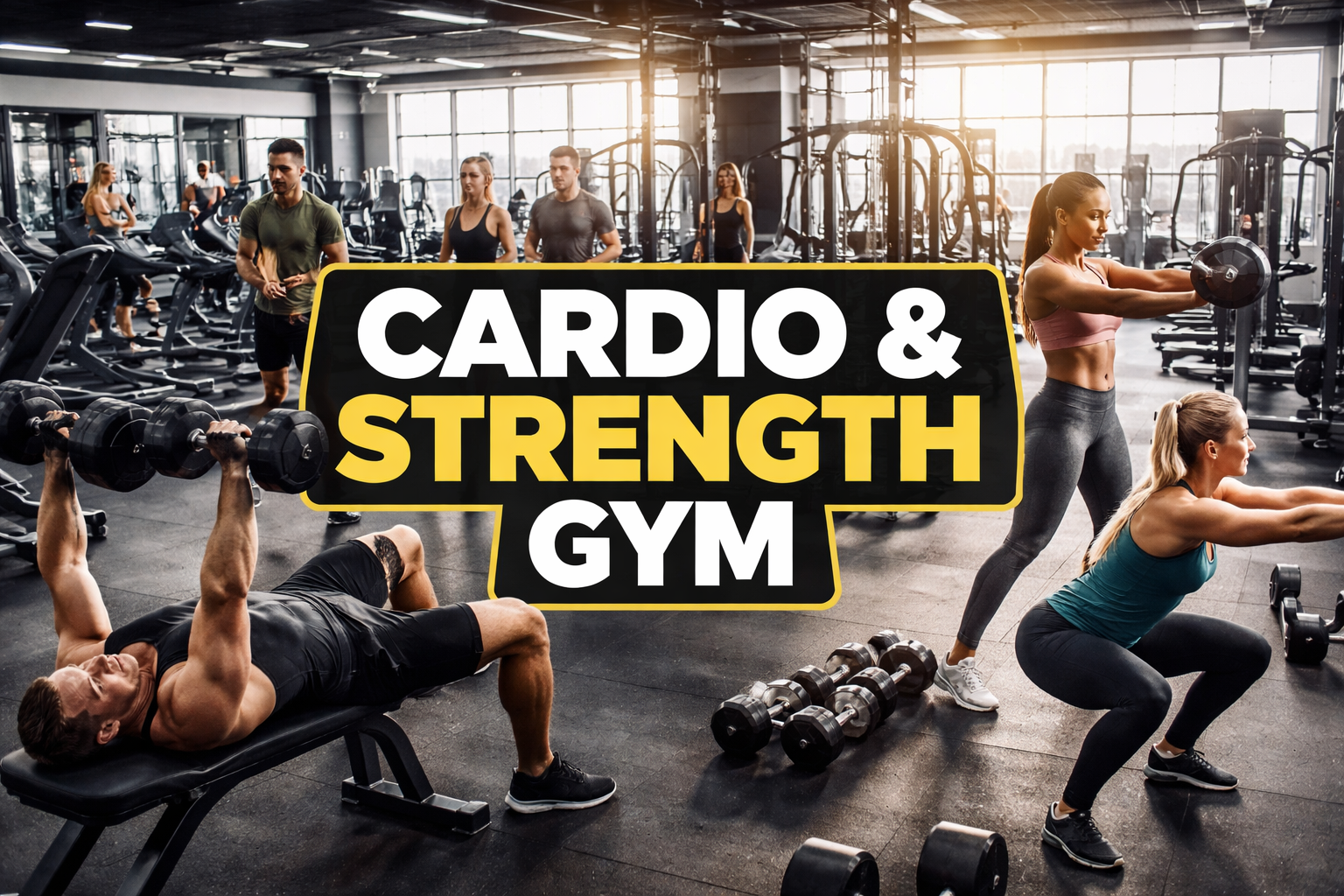
Cardio and Strength Training Effectiveness (Research Data)
| Training Type | Fat Loss | Muscle Gain | Heart Health | Metabolism Boost |
|---|---|---|---|---|
| Cardio only | High (short-term) | Low | High | Moderate |
| Strength only | Moderate | High | Low–Moderate | High |
| Cardio and strength gym (combined) | Very High | High | Very High | Very High |
Source: American College of Sports Medicine (ACSM)
📈 Fat Loss Data: Cardio + Strength vs Cardio Alone
Study Result:
- People who combined cardio and strength training lost 27% more fat
- Maintained lean muscle mass
- Had higher resting metabolism
| Training Approach | Fat Loss | Muscle Retention |
|---|---|---|
| Cardio only | Yes | ❌ Muscle loss |
| Cardio + Strength | Yes (27% more) | ✅ Preserved |
📚 Journal of Applied Physiology
❤️ Heart Health & Strength Training Data
- Strength training reduces blood pressure by 4–6 mmHg
- Cardio training reduces heart disease risk by up to 35%
- Combined training improves VO₂ max by 15–25%
“Resistance training combined with aerobic exercise significantly improves cardiovascular health markers.”
— Harvard Medical School
🔥 Calorie Burn Comparison (1-Hour Workout)
| Activity | Calories Burned (Avg Adult) |
|---|---|
| Treadmill running | 600–700 kcal |
| Weight training | 400–500 kcal |
| HIIT (cardio + strength) | 700–900 kcal |
📌 Insight:
A cardio and strength gym workout burns more total calories when both systems are combined.
🧠 Mental Health & Energy Data
- Exercise reduces stress hormones (cortisol) by 30%
- Strength training improves confidence and mood
- Cardio increases endorphin levels by up to 5x
| Benefit | Cardio | Strength | Combined |
|---|---|---|---|
| Stress relief | High | Moderate | Very High |
| Energy levels | High | High | Highest |
| Mental focus | Moderate | High | High |
📚 Mayo Clinic
🏋️ Muscle Building with Cardio: The Truth (Data)
- Cardio does not kill muscle if limited to 20–30 minutes
- Strength training increases muscle protein synthesis by 50–100%
- Excessive cardio (>60 min/day) may reduce muscle growth
Optimal Ratio (Experts Recommend):
- 70% strength training
- 30% cardio
⏱️ Ideal Weekly Training Frequency (Evidence-Based)
| Goal | Strength Days | Cardio Days |
|---|---|---|
| Weight loss | 3–4 | 3–5 |
| Muscle gain | 4–5 | 2–3 |
| General fitness | 3 | 3 |
📌 Best results occur when training 4–6 days per week in a cardio and strength gym.
🍎 Nutrition Data for Cardio and Strength Gym Members
Pre-Workout
- Carbohydrates increase performance by 15–20%
- Protein reduces muscle breakdown
Post-Workout
- Protein intake improves recovery by 40%
- Carbs restore glycogen levels by 50–60%
| Nutrient | Recommended Intake |
|---|---|
| Protein | 1.6–2.2 g/kg bodyweight |
| Carbs | 3–5 g/kg bodyweight |
| Water | 2.5–3.5 liters/day |
📚 International Society of Sports Nutrition
🚫 Common Mistakes (Data-Based)
- ❌ Doing only cardio → muscle loss
- ❌ Skipping strength → slow metabolism
- ❌ No recovery → performance drops by 20%
- ❌ Poor form → injury risk increases 30–40%
✅ Key Takeaway (Data Summary)
People training in a cardio and strength gym achieve better fat loss, stronger muscles, improved heart health, and higher energy levels than those doing only one type of training.Cardio and Strength Gym – Key Data, Facts, and Research
Cardio and Strength Training Results (Research Overview)
People who train in a cardio and strength gym experience better overall fitness compared to those who follow only one training style.
- Combined cardio and strength training leads to 27% greater fat loss
- Muscle mass is preserved while losing weight
- Resting metabolism increases due to lean muscle development
- Cardiovascular endurance improves faster than cardio-only routines
Source: Journal of Applied Physiology
Fat Loss Comparison: Cardio Only vs Cardio and Strength Gym
Training approach outcomes:
- Cardio-only training burns calories but often results in muscle loss
- Cardio and strength gym training burns fat while maintaining lean muscle
- Muscle preservation leads to higher long-term calorie burn
Fat loss results:
- Cardio-only: short-term weight loss, slower metabolism
- Cardio + strength: sustained fat loss with metabolic improvement
Heart Health and Strength Training Data
Cardio and strength gym training improves heart health significantly:
- Regular cardio reduces heart disease risk by 30–35%
- Strength training lowers blood pressure by 4–6 mmHg
- Combined training improves VO₂ max (oxygen usage) by 15–25%
- Improved circulation and reduced arterial stiffness
Source: American Heart Association, Harvard Medical School
Calorie Burn Data (Average 1-Hour Workout)
Average calorie burn for a 70–80 kg adult:
- Treadmill running: 600–700 calories
- Weight training: 400–500 calories
- HIIT (cardio + strength): 700–900 calories
Insight:
Cardio and strength gym workouts that combine both methods burn more total calories in less time.
Mental Health and Energy Benefits (Evidence-Based)
Exercise benefits mental health in measurable ways:
- Cortisol (stress hormone) levels reduce by up to 30%
- Cardio increases endorphins up to 5 times
- Strength training improves confidence and mental focus
- Combined training delivers the highest energy and mood improvements
Source: Mayo Clinic
Muscle Building with Cardio – What the Data Shows
Scientific findings confirm cardio does not kill muscle when done correctly:
- Cardio sessions under 30 minutes do not interfere with muscle growth
- Strength training increases muscle protein synthesis by 50–100%
- Excessive cardio (over 60 minutes daily) may reduce muscle gains
Recommended ratio:
- 70% strength training
- 30% cardio
Source: International Society of Sports Nutrition
Recommended Weekly Training Frequency
Optimal training frequency in a cardio and strength gym:
- Weight loss: 3–4 strength sessions, 3–5 cardio sessions
- Muscle gain: 4–5 strength sessions, 2–3 cardio sessions
- General fitness: 3 strength sessions, 3 cardio sessions
Best results occur when training 4–6 days per week.
Nutrition Data for Cardio and Strength Gym Members
Protein and carbohydrate intake directly affects performance and recovery.
Recommended intake:
- Protein: 1.6–2.2 grams per kg of body weight
- Carbohydrates: 3–5 grams per kg of body weight
- Water intake: 2.5–3.5 liters per day
Nutrition impact:
- Protein improves muscle recovery by 40%
- Carbohydrates improve workout performance by 15–20%
- Post-workout carbs restore muscle glycogen by 50–60%
Source: International Society of Sports Nutrition
Injury Prevention and Recovery Data
Proper training reduces injury risk significantly:
- Strength training improves joint stability
- Poor form increases injury risk by 30–40%
- Lack of recovery reduces performance by 20%
- Warm-ups reduce muscle strain risk by up to 50%
Key Data Summary for Cardio and Strength Gym
Cardio and strength gym training is the most effective, balanced approach
Combined training delivers better fat loss, muscle retention, and heart health
Cardio alone is not enough for long-term fitness
Strength training alone neglects cardiovascular healthWhy Choose a Cardio and Strength Gym Instead of a Regular Gym?
Choosing the right gym plays a major role in how successful your fitness journey will be. A cardio and strength gym offers clear advantages over traditional gyms that focus on only one training style. Instead of limiting your progress, this type of gym supports fat loss, muscle growth, endurance, and long-term health at the same time.
Most people struggle not because they lack motivation, but because their gym setup does not support balanced training. This is where a cardio and strength gym stands out.
One Gym, Complete Fitness Solution
A cardio and strength gym provides everything your body needs in one place. You don’t need separate memberships or complicated routines. You can perform strength training, cardiovascular exercise, flexibility work, and functional training within the same session.
Key advantages include:
- Full-body workouts under one roof
- No need to switch gyms or programs
- Time-efficient training
- Better workout consistency
Fitness studies show that people who train in multi-purpose gyms are more likely to stick to their routines long term compared to single-focus gym members.
Better Results Than Cardio-Only or Strength-Only Gyms
Traditional gyms often lean heavily toward one training style. This creates imbalances that slow results and increase injury risk.
Comparison overview:
Gym type and results:
- Cardio-focused gyms improve endurance but often cause muscle loss
- Strength-focused gyms build muscle but neglect heart health
- Cardio and strength gyms improve both physical performance and health markers
Research-backed benefits of combined training:
- Higher calorie burn during and after workouts
- Increased lean muscle mass
- Improved cardiovascular endurance
- Stronger joints and bones
According to the American College of Sports Medicine, combined cardio and resistance training leads to superior body composition changes compared to single-method training.
Ideal for Weight Loss and Body Recomposition
A major reason people join a cardio and strength gym is fat loss without losing muscle. Cardio burns calories, while strength training preserves and builds lean mass. Together, they create a powerful fat-loss environment.
Why this matters:
- Muscle increases resting metabolism
- Higher metabolism means more calories burned all day
- Fat loss becomes sustainable, not temporary
Data shows that individuals using both training methods lose significantly more fat while maintaining muscle tone, resulting in a leaner and healthier physique.
Saves Time and Improves Workout Efficiency
Time is one of the biggest barriers to consistent exercise. A cardio and strength gym allows you to:
- Combine cardio and strength in one session
- Use circuit or HIIT-style workouts
- Reduce total weekly training time
For example:
- 45 minutes of combined cardio and strength training can burn more calories than 60 minutes of steady cardio alone
- Shorter workouts improve adherence and consistency
This makes cardio and strength gyms ideal for busy professionals and beginners.
Supports All Fitness Levels and Goals
Unlike specialized gyms that cater only to advanced athletes or beginners, a cardio and strength gym works for everyone.
Suitable for:
- Beginners learning proper movement
- Intermediate trainees building strength
- Advanced lifters improving performance
- Older adults focusing on mobility and heart health
Workouts can be adjusted in intensity, resistance, and duration, making progress safe and sustainable.
Professional Guidance and Safer Training Environment
Most cardio and strength gyms employ trainers who understand balanced programming. This reduces the risk of common mistakes such as overdoing cardio or skipping strength training.
Safety benefits include:
- Better exercise form
- Reduced injury risk
- Proper warm-up and recovery guidance
- Structured workout plans
Data shows that supervised or guided training reduces injury risk by 30–40% compared to unsupervised workouts.
Long-Term Health Benefits Beyond Appearance
A cardio and strength gym doesn’t just improve how you look—it improves how your body functions.
Long-term health improvements include:
- Reduced risk of heart disease
- Improved insulin sensitivity
- Stronger bones and joints
- Better posture and balance
- Lower stress and anxiety levels
According to Harvard Medical School, combining cardio and strength training improves longevity and quality of life, especially as people age.
Key Takeaway
A cardio and strength gym is not just a place to work out—it’s a complete fitness system. It supports fat loss, muscle growth, heart health, and mental well-being in one balanced approach. Compared to regular gyms, it delivers faster results, better health outcomes, and long-term sustainability.Key Benefits of Training at a Cardio and Strength Gym
Training at a cardio and strength gym offers benefits that go far beyond basic weight loss or muscle building. By combining cardiovascular exercise with resistance training, this type of gym supports total-body transformation, long-term health, and sustainable fitness progress. Below are the most important benefits explained in a simple and practical way.
Improves Fat Loss and Muscle Definition
One of the biggest advantages of a cardio and strength gym is its ability to help you lose fat without losing muscle. Cardio burns calories during the workout, while strength training builds lean muscle that continues to burn calories even when you are resting.
Why this combination works:
- Cardio increases immediate calorie burn
- Strength training raises resting metabolic rate
- Muscle definition improves as body fat decreases
Scientific data shows that people who combine cardio and strength training lose more body fat and maintain a lean, toned appearance compared to those who do cardio alone.
Boosts Metabolism for Long-Term Results
A slow metabolism is one of the main reasons people struggle with weight gain. Strength training in a cardio and strength gym helps speed up metabolism by increasing lean muscle mass.
Metabolic benefits include:
- Muscle burns more calories than fat
- Strength training raises metabolism for up to 48 hours
- Fat loss becomes easier over time
This means results last longer, even if calorie intake increases slightly.
Enhances Heart Health and Physical Strength
A cardio and strength gym strengthens both the heart and muscles, which is essential for long-term health.
Health improvements include:
- Lower blood pressure
- Improved circulation
- Stronger heart muscles
- Increased endurance for daily activities
Studies show that combining resistance training with cardio improves heart health markers more than cardio alone.
Increases Energy Levels and Daily Performance
Regular training at a cardio and strength gym leads to noticeable improvements in energy, focus, and productivity.
Benefits you’ll feel daily:
- Less fatigue during work and daily tasks
- Improved oxygen delivery to muscles
- Better stamina and strength
People who exercise regularly report higher energy levels and reduced feelings of exhaustion throughout the day.
Supports Mental Health and Stress Reduction
Exercise is one of the most effective natural ways to improve mental health. A cardio and strength gym helps regulate stress hormones while boosting mood-enhancing chemicals in the brain.
Mental health benefits include:
- Reduced stress and anxiety
- Improved mood and confidence
- Better sleep quality
- Reduced risk of depression
Cardio releases endorphins, while strength training improves self-confidence. Together, they provide strong mental health support.
Improves Bone Density and Joint Health
Strength training is essential for bone health, especially as people age. When combined with low-impact cardio, it helps protect joints and reduce injury risk.
Key benefits:
- Increased bone density
- Stronger connective tissues
- Improved joint stability
- Reduced risk of osteoporosis
This makes cardio and strength gyms ideal for long-term fitness and aging populations.
Adaptable for All Fitness Levels
One of the strongest benefits of a cardio and strength gym is its flexibility. Workouts can be easily adjusted based on experience, age, and fitness goals.
Works well for:
- Beginners starting their fitness journey
- Intermediate gym members improving performance
- Advanced lifters training for strength or endurance
- Older adults maintaining mobility and balance
Exercises can be scaled by changing weight, intensity, or duration.
Prevents Workout Plateaus
Training only one way often leads to stalled progress. A cardio and strength gym prevents plateaus by constantly challenging the body in different ways.
Why plateaus are avoided:
- Different energy systems are trained
- Muscles adapt faster with varied stimulus
- Recovery improves through balanced programming
This leads to steady, long-term progress without burnout.
Key Takeaway
Training in a cardio and strength gym delivers faster results, better health, and greater consistency than traditional gyms. The combination of cardio and strength training supports fat loss, muscle development, heart health, mental well-being, and overall performance in one powerful system.Cardio Equipment You’ll Find in a Cardio and Strength Gym
A major advantage of a cardio and strength gym is access to a wide variety of cardio machines designed to improve heart health, endurance, and calorie burn. Each machine targets the cardiovascular system differently, allowing members to choose equipment based on fitness level, joint health, and personal goals.
Understanding how each machine works helps you train more effectively and avoid common mistakes.
Treadmills
Treadmills are one of the most popular cardio machines in any cardio and strength gym. They allow users to walk, jog, or run at controlled speeds and inclines.
Benefits of treadmill training:
- Improves heart and lung function
- Supports fat loss and endurance
- Allows incline walking for lower-impact fat burning
Walking on an incline can burn nearly the same calories as running while placing less stress on the joints. This makes treadmills suitable for beginners, weight loss clients, and advanced runners.
Stationary Bikes and Spin Bikes
Stationary bikes are ideal for those who want a low-impact cardio workout. They reduce stress on the knees and ankles while still providing excellent cardiovascular benefits.
Key benefits:
- Burns calories without joint strain
- Improves leg strength and endurance
- Suitable for all age groups
Spin bikes offer higher intensity and are often used in interval training or group classes. They are especially effective for fat loss and cardiovascular conditioning.
Elliptical Machines
Ellipticals provide a smooth, gliding motion that combines upper and lower body movement. This makes them a favorite in cardio and strength gyms for people with joint issues.
Advantages include:
- Full-body cardio workout
- Minimal impact on joints
- Suitable for longer training sessions
Ellipticals can burn nearly as many calories as running while reducing injury risk.
Rowing Machines
Rowing machines are one of the most effective cardio tools because they combine cardio and strength in a single movement.
Key benefits:
- Trains both upper and lower body
- Improves posture and core strength
- High calorie burn in short time
Rowing is often used in HIIT workouts because it challenges endurance, strength, and coordination simultaneously.
Stair Climbers and Steppers
Stair climbers mimic climbing stairs, targeting the lower body while raising heart rate quickly.
Benefits include:
- High calorie burn
- Strengthens glutes and legs
- Improves cardiovascular endurance
They are particularly effective for those looking to tone the lower body while improving heart health.
Cardio Equipment Comparison Overview
Each machine serves a unique purpose within a cardio and strength gym:
- Treadmills: best for walking and running endurance
- Bikes: low-impact fat burning
- Ellipticals: joint-friendly full-body cardio
- Rowers: cardio plus strength combination
- Stair climbers: intense lower-body conditioning
Using a variety of machines prevents boredom, reduces overuse injuries, and improves overall fitness results.
How to Choose the Right Cardio Machine
Selecting the right cardio equipment depends on:
- Fitness level
- Joint health
- Weight loss or endurance goals
- Time availability
Beginners may benefit from bikes and ellipticals, while advanced trainees can use treadmills, rowers, and stair climbers for higher intensity sessions.
Key Takeaway
The cardio equipment in a cardio and strength gym is designed to support all fitness goals—from weight loss to endurance training. When combined with strength training, these machines help deliver faster, safer, and more sustainable results.Strength Training Equipment in a Cardio and Strength Gym
Strength training is the foundation of long-term fitness, and a cardio and strength gym provides a wide range of equipment to build muscle, increase strength, and improve overall body function. Unlike cardio machines, strength equipment focuses on resistance, which forces muscles to adapt and grow stronger over time.
Understanding how each type of strength equipment works allows you to train safely and efficiently.
Free Weights (Dumbbells and Barbells)
Free weights are a core feature of every cardio and strength gym. They allow natural movement patterns and engage multiple muscle groups at once.
Benefits of free weight training:
- Builds functional strength
- Improves balance and coordination
- Activates stabilizing muscles
- Allows progressive overload
Common free weight exercises include squats, deadlifts, bench presses, rows, and shoulder presses. These compound movements provide maximum muscle activation and calorie burn.
Weight Machines
Weight machines are designed to guide movement along a fixed path, making them ideal for beginners and rehabilitation training.
Advantages of weight machines:
- Safer for new gym members
- Helps isolate specific muscles
- Reduces injury risk
- Easy to control resistance
Machines are especially useful for targeting muscles like the chest, back, legs, and shoulders with controlled form.
Functional Training Areas
Many cardio and strength gyms include functional training zones equipped with tools that improve real-life movement.
Common functional equipment includes:
- Kettlebells
- Resistance bands
- Medicine balls
- TRX suspension trainers
Functional training improves core stability, balance, coordination, and mobility. It is highly effective for athletes and people focused on everyday strength.
Bodyweight Training Stations
Bodyweight exercises are an important part of strength training and are commonly supported in cardio and strength gyms.
Popular bodyweight exercises:
- Push-ups
- Pull-ups
- Dips
- Planks
- Lunges
These exercises improve relative strength and are excellent for beginners and advanced users alike.
Core Training Equipment
A strong core supports all movements and reduces injury risk.
Core-focused tools include:
- Ab rollers
- Cable machines
- Stability balls
Core training improves posture, balance, and athletic performance.
Strength Equipment Comparison Overview
Each type of strength equipment plays a specific role:
- Free weights: best for muscle growth and functional strength
- Machines: ideal for safety and muscle isolation
- Functional tools: improve mobility and coordination
- Bodyweight stations: build endurance and control
Using a mix of equipment leads to balanced muscle development and better results.
How Strength Training Supports Cardio Performance
Strength training in a cardio and strength gym does more than build muscle. It improves cardio performance by:
- Increasing muscular endurance
- Improving movement efficiency
- Reducing fatigue during cardio sessions
Stronger muscles require less effort to perform the same cardio activity, allowing longer and more effective workouts.
Key Takeaway
The strength training equipment in a cardio and strength gym provides the tools needed to build muscle, protect joints, and support fat loss. When combined with cardio training, it creates a powerful, balanced fitness program suitable for all experience levels.How to Combine Cardio and Strength Training Effectively
Knowing how to combine cardio and strength training is the key to maximizing results in a cardio and strength gym. Doing both correctly ensures you burn fat, build muscle, and improve heart health without overtraining or compromising performance.
There are several approaches, and the best method depends on your fitness goals, experience level, and schedule.
Cardio Before Strength – When It Works
Doing cardio before strength training is sometimes recommended if your goal is endurance or heart health.
Benefits:
- Warms up the body and joints
- Improves aerobic capacity
- Prepares muscles for sustained effort
Considerations:
- Doing long, intense cardio before lifting can reduce strength performance
- Best for beginners or those focusing on fat loss
For example, 15–20 minutes of moderate treadmill walking or cycling before lifting weights can serve as a warm-up while also boosting calorie burn.
Strength Before Cardio – Ideal for Muscle and Fat Loss
Many experts recommend performing strength training first, especially for those prioritizing muscle building or fat loss.
Benefits:
- Muscles are fresh, allowing heavier lifts
- Improves strength gains and muscle definition
- Allows shorter, more intense cardio after lifting
Doing strength training first followed by cardio ensures you maximize both muscle growth and calorie burn. For example, lifting weights for 30–45 minutes and then finishing with 15–20 minutes of HIIT on a bike or treadmill is highly effective.
Split Training vs Same-Day Training
There are two main ways to combine cardio and strength:
- Split Days
- Example: Monday/Wednesday/Friday – Strength
- Tuesday/Thursday – Cardio
- Advantages: More focus on each training type, better recovery
- Ideal for advanced lifters or those with flexible schedules
- Same-Day Hybrid Training
- Example: 30–40 minutes of strength + 20 minutes of cardio in one session
- Advantages: Time-efficient, balanced stimulus for all energy systems
- Ideal for beginners, busy professionals, or fat-loss-focused workouts
Both methods are effective; the key is consistency and intensity, not which method is used exclusively.
High-Intensity Interval Training (HIIT) for Hybrid Workouts
HIIT combines short bursts of intense activity with recovery periods, making it ideal for cardio and strength gyms.
Example:
- 30 seconds of kettlebell swings (strength)
- 30 seconds of stationary bike sprint (cardio)
- Repeat for 15–20 minutes
Benefits:
- Burns more calories in less time
- Improves heart health and muscular endurance
- Retains lean muscle while losing fat
HIIT is especially effective for people who want efficient workouts without spending hours in the gym.
Key Principles for Combining Cardio and Strength
- Prioritize Your Goal: Muscle gain first, cardio second; fat loss may be flexible.
- Balance Volume and Intensity: Avoid overtraining by adjusting sets, reps, and duration.
- Include Recovery: At least one full rest day per week to allow muscle repair.
- Mix Equipment: Use treadmills, bikes, free weights, and machines to prevent boredom and plateaus.
- Track Progress: Monitor strength, endurance, and body composition to optimize workouts.
Key Takeaway
The most effective way to combine cardio and strength training in a cardio and strength gym depends on your goal, fitness level, and schedule. Whether you do cardio first, strength first, or hybrid HIIT sessions, the combination will maximize fat loss, build muscle, improve endurance, and enhance overall health when programmed consistently.Best Cardio and Strength Gym Workout Plans
Creating a structured workout plan is essential for making the most of a cardio and strength gym. A well-designed plan balances cardio and strength, ensures recovery, and progressively challenges the body to deliver results. Below, we outline plans for beginners, intermediate, and advanced gym-goers.
Beginner Cardio and Strength Gym Workout Plan
For beginners, the focus is on learning proper form, building endurance, and establishing consistency. Start with moderate intensity and gradually increase weight and duration.
Weekly Schedule Example:
- Monday: Strength – full-body machines and free weights (30–40 min)
- Tuesday: Cardio – treadmill walking or cycling (20–30 min)
- Wednesday: Rest or light stretching
- Thursday: Strength – bodyweight and free weights (30–40 min)
- Friday: Cardio – elliptical or rowing machine (20–30 min)
- Saturday: Optional light cardio or mobility training
- Sunday: Rest
Tips for Beginners:
- Use machines for safety
- Focus on major muscle groups: chest, back, legs, arms
- Start with 2–3 sets of 10–12 reps per exercise
- Gradually increase cardio intensity as endurance improves
Intermediate Cardio and Strength Gym Workout Plan
Intermediate trainees should focus on progressive overload and increased workout intensity to continue making gains.
Weekly Schedule Example:
- Monday: Upper-body strength + 15 min HIIT cardio
- Tuesday: Lower-body strength + 15 min moderate cardio
- Wednesday: Rest or mobility work
- Thursday: Full-body strength + 20 min cardio intervals
- Friday: Cardio – treadmill or rowing (30–40 min)
- Saturday: Optional functional training or circuit
- Sunday: Rest
Intermediate Tips:
- Mix free weights and functional equipment
- Include compound lifts like squats, deadlifts, bench press
- Use HIIT to improve cardiovascular fitness and calorie burn
- Track weight lifted and cardio performance weekly
Advanced Cardio and Strength Training Program
Advanced members combine heavy lifting, high-intensity cardio, and performance-focused training for maximal results.
Weekly Schedule Example:
- Monday: Strength – heavy compound lifts + 20 min HIIT
- Tuesday: Cardio – endurance or intervals (30–40 min)
- Wednesday: Functional training + core (45 min)
- Thursday: Strength – hypertrophy focus + short cardio (15–20 min)
- Friday: HIIT cardio + plyometrics (30 min)
- Saturday: Optional full-body circuit or mobility work
- Sunday: Rest and recovery
Advanced Tips:
- Focus on specific goals: muscle gain, fat loss, or athletic performance
- Incorporate periodization (varying intensity weekly)
- Include mobility and core exercises to prevent injury
- Ensure nutrition supports high-intensity training
Important Notes for All Plans
- Warm-Up and Cool-Down: Always 5–10 minutes to prevent injury
- Progressive Overload: Gradually increase weights, reps, or intensity
- Consistency Over Perfection: Regular workouts produce better results than sporadic high-intensity sessions
- Rest and Recovery: Muscles grow during rest; overtraining slows progress
Key Takeaway
No matter your fitness level, a structured cardio and strength gym workout plan ensures balanced development, fat loss, and improved endurance. Beginners focus on consistency and technique, intermediates on intensity and progression, and advanced users on performance, hypertrophy, and functional fitness. Following a clear plan maximizes results while reducing injury risk.Cardio and Strength Gym for Weight Loss
A cardio and strength gym is one of the most effective environments for fat loss because it combines two powerful mechanisms: calorie burning through cardio and metabolism-boosting through strength training. Unlike relying on cardio alone, this combination helps you lose fat while preserving lean muscle, which is essential for long-term weight management.
How Cardio and Strength Work Together for Fat Loss
- Cardio Burns Calories During Workouts
- Running, cycling, rowing, and HIIT increase energy expenditure
- High-intensity cardio can burn up to 700–900 calories per hour
- Helps create the calorie deficit needed for fat loss
- Strength Training Boosts Metabolism After Exercise
- Muscle tissue burns more calories at rest than fat
- Resistance training can increase resting metabolic rate by 7–10%
- Strength sessions complement cardio by preserving and building muscle
- Combined Training Enhances Fat Loss Efficiency
- Studies show combining cardio and strength results in 27% more fat loss than cardio alone
- Prevents the common issue of “skinny-fat,” where fat is lost but muscle also diminishes
Best Cardio Types for Fat Loss
Some cardio machines and methods are more effective for fat loss when combined with strength training:
- Treadmill HIIT sprints: Short bursts of high speed, alternating with walking or slow jogging
- Rowing machine intervals: Combines upper and lower body for full-body calorie burn
- Elliptical with resistance: Low-impact, sustainable for longer workouts
- Spin classes: Group-based high-intensity sessions to burn maximum calories
How Strength Training Supports Weight Loss
Strength training is critical to maintaining a lean, toned physique:
- Preserves muscle mass while you are in a calorie deficit
- Improves posture and body composition
- Increases strength, making everyday activities easier
- Supports higher calorie burn even on rest days
Compound lifts such as squats, deadlifts, bench presses, and rows provide the most effective fat-burning stimulus because they engage multiple muscle groups simultaneously.
Example Fat-Loss Workout in a Cardio and Strength Gym
Duration: 60 minutes
- Warm-up – 5–10 min treadmill walking or cycling
- Strength Circuit – 3 rounds
- Squats (10 reps)
- Bench Press (10 reps)
- Bent-over Rows (10 reps)
- Plank Hold (30–45 sec)
- Cardio Intervals – 20 min
- Rowing machine: 1 min sprint / 1 min easy row
- Cool-down – 5 min stretching
This hybrid approach maximizes calorie burn and muscle retention, making it highly effective for weight loss.
Key Takeaway
A cardio and strength gym is the most efficient place for sustainable weight loss. Cardio helps create a calorie deficit, while strength training preserves and builds muscle. Together, they improve metabolism, enhance body composition, and ensure fat is lost in the healthiest way possible.Cardio and Strength Gym for Weight Loss
A cardio and strength gym is one of the most effective environments for fat loss because it combines two powerful mechanisms: calorie burning through cardio and metabolism-boosting through strength training. Unlike relying on cardio alone, this combination helps you lose fat while preserving lean muscle, which is essential for long-term weight management.
How Cardio and Strength Work Together for Fat Loss
- Cardio Burns Calories During Workouts
- Running, cycling, rowing, and HIIT increase energy expenditure
- High-intensity cardio can burn up to 700–900 calories per hour
- Helps create the calorie deficit needed for fat loss
- Strength Training Boosts Metabolism After Exercise
- Muscle tissue burns more calories at rest than fat
- Resistance training can increase resting metabolic rate by 7–10%
- Strength sessions complement cardio by preserving and building muscle
- Combined Training Enhances Fat Loss Efficiency
- Studies show combining cardio and strength results in 27% more fat loss than cardio alone
- Prevents the common issue of “skinny-fat,” where fat is lost but muscle also diminishes
Best Cardio Types for Fat Loss
Some cardio machines and methods are more effective for fat loss when combined with strength training:
- Treadmill HIIT sprints: Short bursts of high speed, alternating with walking or slow jogging
- Rowing machine intervals: Combines upper and lower body for full-body calorie burn
- Elliptical with resistance: Low-impact, sustainable for longer workouts
- Spin classes: Group-based high-intensity sessions to burn maximum calories
How Strength Training Supports Weight Loss
Strength training is critical to maintaining a lean, toned physique:
- Preserves muscle mass while you are in a calorie deficit
- Improves posture and body composition
- Increases strength, making everyday activities easier
- Supports higher calorie burn even on rest days
Compound lifts such as squats, deadlifts, bench presses, and rows provide the most effective fat-burning stimulus because they engage multiple muscle groups simultaneously.
Example Fat-Loss Workout in a Cardio and Strength Gym
Duration: 60 minutes
- Warm-up – 5–10 min treadmill walking or cycling
- Strength Circuit – 3 rounds
- Squats (10 reps)
- Bench Press (10 reps)
- Bent-over Rows (10 reps)
- Plank Hold (30–45 sec)
- Cardio Intervals – 20 min
- Rowing machine: 1 min sprint / 1 min easy row
- Cool-down – 5 min stretching
This hybrid approach maximizes calorie burn and muscle retention, making it highly effective for weight loss.
Key Takeaway
A cardio and strength gym is the most efficient place for sustainable weight loss. Cardio helps create a calorie deficit, while strength training preserves and builds muscle. Together, they improve metabolism, enhance body composition, and ensure fat is lost in the healthiest way possible.Cardio and Strength Gym for Muscle Building
While cardio is often associated with fat loss, a cardio and strength gym is also ideal for building lean muscle and increasing strength. Strength training remains the core driver of muscle growth, but strategically incorporating cardio can improve recovery, endurance, and overall performance.
How Strength Training Builds Muscle
Muscle growth, also known as hypertrophy, occurs when muscle fibers experience tension and small micro-tears during resistance exercises. The body repairs these fibers stronger than before, which increases both muscle size and strength.
Key principles:
- Progressive overload: Gradually increasing weights or resistance
- Compound lifts: Exercises like squats, deadlifts, bench presses, and pull-ups engage multiple muscle groups for maximum growth
- Consistency: Training at least 3–4 times per week for each major muscle group
Role of Cardio in Muscle Building
Although excessive cardio can interfere with muscle growth, moderate cardio is beneficial for muscle building:
- Improves cardiovascular efficiency, allowing better blood flow to muscles
- Enhances recovery by delivering oxygen and nutrients faster
- Supports endurance, so you can train heavier and longer
- Helps maintain a lean physique while building muscle
Recommended cardio types for muscle builders:
- Low to moderate-intensity steady-state cardio (walking, cycling, elliptical)
- Short HIIT sessions post-strength training
Limiting cardio sessions to 20–30 minutes ensures it supports muscle growth without causing fatigue or calorie deficits that hinder hypertrophy.
Effective Muscle-Building Workout in a Cardio and Strength Gym
Duration: 60–75 minutes
- Warm-up – 5–10 min light cardio or dynamic stretching
- Strength Training – Focus on compound lifts (40–50 min)
- Squats: 4 sets of 8–10 reps
- Bench Press: 4 sets of 8–10 reps
- Bent-over Rows: 4 sets of 8–10 reps
- Shoulder Press: 3 sets of 10 reps
- Cardio – Optional 15–20 min low-intensity elliptical or bike
- Cool-down – 5–10 min stretching and mobility
This combination maximizes muscle growth while keeping cardiovascular fitness intact.
Nutritional Support for Muscle Gain
Muscle growth is impossible without proper nutrition. A cardio and strength gym member should focus on:
- Protein: 1.6–2.2 g per kg of body weight per day for muscle repair
- Carbohydrates: 3–5 g per kg to fuel workouts and recovery
- Healthy fats: Support hormones that regulate growth
- Hydration: 2.5–3.5 liters daily to maintain performance
Supplements like whey protein, creatine, and BCAAs can help, but whole foods remain the priority.
Key Takeaway
A cardio and strength gym supports muscle building by providing the equipment, space, and programming necessary for hypertrophy while maintaining cardiovascular fitness. Strategic cardio improves endurance and recovery, strength training builds lean muscle, and proper nutrition ensures optimal results.